
GuideShows how a TheirStack feature works and how to use it.
How do I make my AI sales agent research companies better?
Give your AI sales agent tools that return current hiring and tech stack facts per company, with the MCP setup and a real account research run.
Give the agent a tool that returns current, dated facts about each company, and tell it to call that tool before it writes a word about an account. A language model only knows what was in its training data. The current Claude models, for example, have a training data cutoff of June 2026 (Anthropic's models overview). Ask one of them in November what a company is hiring for, or which data warehouse its engineers use this quarter, and it can only guess from older pages or make something up.
Hiring and tech stack facts change faster than models are retrained. On 10 November 2026, 761 US direct employers had an open data engineer job posted in the last 30 days that names Snowflake, across 1,266 job posts. Every one of those posts went up after that cutoff, so no model has read them.
Letting the model browse the web closes part of the gap, slowly. The agent has to find the careers page, load it, read the HTML, follow each post and work out on its own which listings on different job boards are the same job. It still has to turn that text into fields, deduplicate the listings and count how many posts mention each technology. A data tool answers the same question in one call with structured fields per company. It returns the technology, how many of the company's job posts mention it, when it was first and last seen, and how confident the match is.
This guide sets that up with TheirStack, whose MCP server and API return job, company and technology data built from job posts.
Which three tools does a research agent need, and what do they cost?
Three tools cover most account research. Each is an MCP tool and also an API endpoint, and an MCP call costs the same credits as the API call it wraps (MCP pricing).
| MCP tool | API endpoint | What the agent gets | Cost |
|---|---|---|---|
search_companies | POST /v1/companies/search | Companies that match firmographics, technologies and the jobs they post, with the jobs that matched | 3 API credits per company returned |
get_company_technographics | POST /v1/companies/technologies | Every technology mentioned in the company's job posts, with confidence, job counts for the last 7, 30 and 180 days, and the first and last dates found | 3 API credits per company lookup |
get_company_buying_intents | POST /v1/companies/buying_intents | The buying intent topics detected in its job posts, with the same fields | 3 API credits per company lookup |
A lookup that finds nothing costs nothing (technographics, buying intents). Researching one account with both lookups costs 6 API credits.
You need a TheirStack account with an API key, and either an agent that can call MCP tools or your own backend calling the API.
How do you connect the agent and check what it will see?
- Create an API key in API Keys. For an agent that runs unattended, use the key rather than OAuth. It doesn't expire until you revoke it, and most MCP clients don't refresh OAuth tokens cleanly.
- Add the MCP server at
https://api.theirstack.com/mcp, sendingAuthorization: Bearer <YOUR_API_KEY>. In Claude Code that isclaude mcp add TheirStack --transport http https://api.theirstack.com/mcp --header "Authorization: Bearer <YOUR_API_KEY>". The MCP page has the config for Cursor, ChatGPT, VS Code, Codex and other clients. - Give the agent an order of work in its system prompt. It finds accounts with
search_companies, callsget_company_technographicsandget_company_buying_intentsfor each account before writing anything about it, and quotes the dates the tools return. - Open the agent's first search in the app to see the companies it will get. In Company Search, add Job Title contains any of
data engineer, Job Technology Snowflake, Job Posted date since 30 days ago, Job Closed open jobs only, Job Country United States and Company Type Direct employer.
The same search, as a message for the agent, an API request or the app's filters:
Using the TheirStack MCP, find US companies hiring data engineers who work with Snowflake. Look for:
- Companies with a job title containing data engineer
- Jobs that mention Snowflake
- Jobs posted in the last 30 days that are still open
- Jobs in the United States
- Direct employers, not recruiting agencies
Tell me how many companies match, then list the first 10 with the job title that matched.


curl -X POST "https://api.theirstack.com/v1/companies/search" \
  -H "Authorization: Bearer <YOUR_API_KEY>" \
  -H "Content-Type: application/json" \
  -d '{
    "job_filters": {
      "job_title_or": ["data engineer"],
      "job_technology_slug_or": ["snowflake"],
      "posted_at_max_age_days": 30,
      "is_closed": false,
      "job_country_code_or": ["US"]
    },
    "company_type": "direct_employer",
    "limit": 10
}'- Job Titlecontains any of data engineer
- Job Technologyis any of Snowflake
- Job Posted datesince 30 days ago
- Job Closedis closed No
- Job CountryUnited States
- Company TypeDirect employer
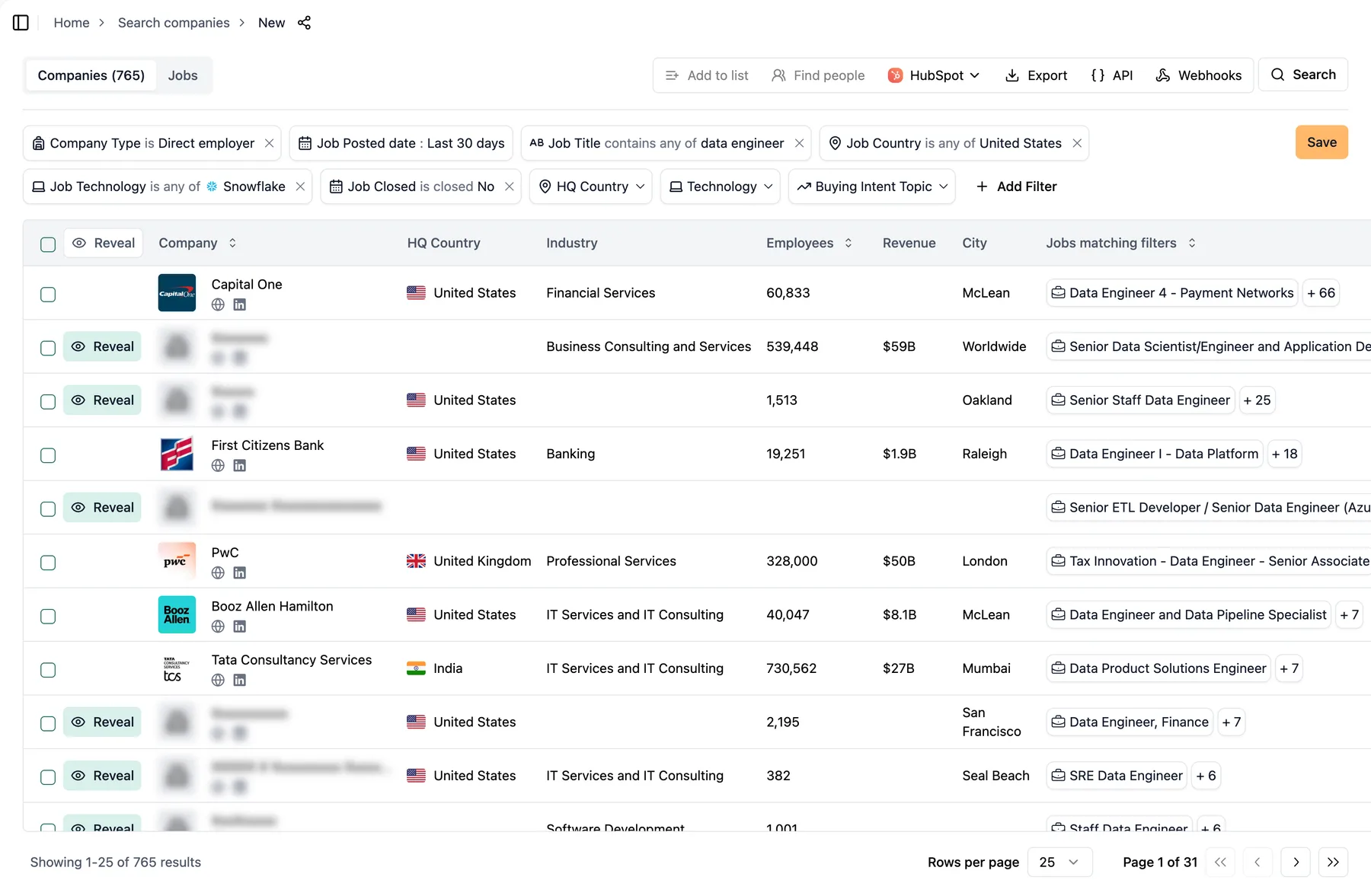
The company search above lists each US company with a recent data engineer opening that names Snowflake, which is the list the agent starts from.
What does an agent's research on one account look like?
We ran it on 10 November 2026 for a seller of a tool that works on top of Snowflake. The account is a US space hardware manufacturer with about 350 employees, and we leave its name out.
- Find the account. The agent calls
search_companieswith the filters above and gets 761 companies. One of them posted a Data Engineer job on 10 November 2026 that names Snowflake, PostgreSQL, Amazon Web Services, Kubernetes and Amazon Redshift. - Read its tech stack. It calls
get_company_technographicswith the company's domain. Python comes back with high confidence across 576 job posts, 105 of them in the last 30 days, alongside Kubernetes, Amazon Web Services, Terraform and PostgreSQL. Snowflake has high confidence in 26 posts, first found on 16 October 2025 and last on 6 November 2026, and it takes 81% of the company's data warehouse mentions. Amazon Redshift has medium confidence in 6 posts and takes the other 19%, last seen on 24 September 2026. - Read what's new. It calls
get_company_buying_intentswithfirst_date_found_gteset to 2026-08-01, so only topics the company started mentioning in the last three months come back. Photonics leads, in 13 posts since 22 September 2026, 11 of them in the last 30 days. Identity providers and phishing follow, both first found on 19 August 2026, in 11 posts each. - Write the brief. From those calls the agent can report a current data engineer opening, more job-post mentions of Snowflake than Redshift, and security and photonics topics first detected this autumn. Each claim carries a date from a tool, and none comes from the model's memory.
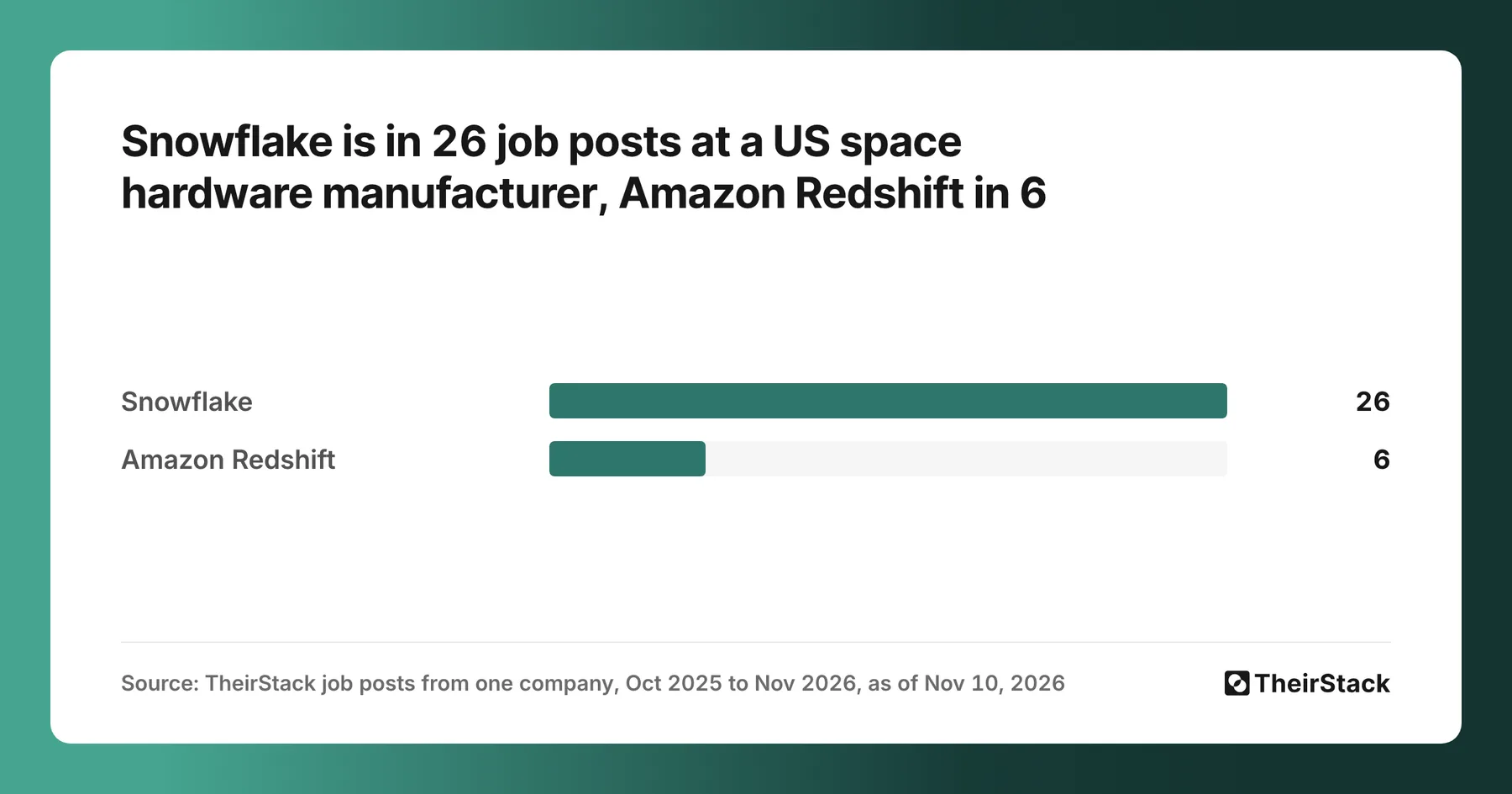 Snowflake is in 26 job posts at a US space hardware manufacturer, Amazon Redshift in 6
The chart compares how many of the account's job posts name each data warehouse.
Steps 2 and 3, for any account you give the agent:
Using the TheirStack MCP, research the company at <ACCOUNT_DOMAIN> before I write to it. Look for:
- Its data warehouse technologies, with confidence, job counts and the first and last dates found
- Buying intent topics first found in its job posts on or after 2026-08-01
Tell me which warehouse appears in the most job posts, which topics were first detected after the cutoff, and the dates behind each.
curl -X POST "https://api.theirstack.com/v1/companies/technologies" \
  -H "Authorization: Bearer <YOUR_API_KEY>" \
  -H "Content-Type: application/json" \
  -d '{
    "company_domain": "<ACCOUNT_DOMAIN>",
    "keyword_category_slug_or": ["data-warehousing"]
  }'

curl -X POST "https://api.theirstack.com/v1/companies/buying_intents" \
  -H "Authorization: Bearer <YOUR_API_KEY>" \
  -H "Content-Type: application/json" \
  -d '{
    "company_domain": "<ACCOUNT_DOMAIN>",
    "first_date_found_gte": "2026-08-01",
    "limit": 10
}'How do you keep the agent from reading noise?
The lookups return everything by default, and an agent reads everything it gets. These parameters keep its context on what your product touches.
keyword_slug_oronget_company_technographicsreturns only the technologies you list, andkeyword_category_slug_orreturns one category, such asdata-warehousing. Unfiltered, our example account's stack starts with its applicant tracking system.first_date_found_gteonget_company_buying_intentskeeps only new topics. Without it, the top topics for our example account were labour law, salary range and paid time off, each in about 1,500 job posts, which is the standard text at the end of US job ads.confidence_orset tohighdrops technologies mentioned in passing, andmin_jobssets how many posts a technology needs before it counts.min_num_jobs_foundonsearch_companieskeeps companies with at least that many matching jobs, so the agent spends its lookups on teams that are growing.limiton each call caps how many records come back.
Where do these tools fall short for a research agent?
- We only see companies that post jobs. A company that doesn't hire, or doesn't name its tools in job posts, comes back with a thin stack or none.
- The facts come from job posts. They show what a company hires for and names, which is strong evidence of what it uses, but they aren't a scan of its systems. The confidence level and job counts are there for the agent to weigh each one.
- Look companies up by domain.
company_namehas to match exactly and is case sensitive, socompany_domainfinds the company more reliably. - Every call is billed on its own, so looking up the same company again costs its credits again (how API credits work).
- Direct employer separates companies from recruiting agencies, not by industry. Among the first matches of our search was an IT consulting firm hiring an SRE data engineer, so add an Industry filter when consultancies aren't your buyers.
- Job, company, technographics and buying intent searches share one rate limit per user, 10 per minute on the free plan. An agent that researches a list in parallel should queue its calls.
- If your MCP client keeps asking you to log in again, switch from OAuth to the API key.
To try it on your own accounts, open the data engineer search, swap Snowflake for the technology your product works with, and give your agent the tools from the MCP tools reference.
TheirStack: integrations with AI assistants, automations and CRMs
TheirStack works with the AI assistants, automation tools and CRMs you already use: ask Claude or ChatGPT through the MCP server, send new matches to Clay, n8n, Make or Zapier by webhook, and create leads in Salesforce or HubSpot.
AI assistants
Ask Claude, ChatGPT, Cursor or any MCP client to search jobs, companies and tech stacks through the TheirStack MCP server.
MCP server
https://api.theirstack.com/mcpAutomations
TheirStack sends every new matching company by webhook as soon as it finds it, to your automation platform or through it into your CRM and sales tools.
CRMs and sales tools
 VS Code
 Windsurf
 Cline
 OpenCode
 Gemini
 Hermes
 OpenClaw
 Clay
 n8n
 Make
 Zapier
 Databar
 Salesforce
 HubSpot
 Attio
 Pipedrive
 Apollo
 Instantly
 ContactOut
Give your agent current facts about every account
Connect the TheirStack MCP server and your agent checks hiring, tech stack and buying intent before it writes to anyone.
Start free: 200+ free credits.
How is this guide?
Last updated on
MCP and AI agent guides
Guides to the TheirStack MCP server. Connect your AI assistant or sales agent to TheirStack, research companies with live job and tech data, and build a job newsletter.
How to create a niche job newsletter with TheirStack MCP
Learn how to create a weekly curated job newsletter using Claude.ai and TheirStack MCP. Automate job newsletter creation with a reusable template — no code needed.