

TheirStack and Sumble are both powerful platforms that transform job postings into actionable sales intelligence and technographic data.
TheirStack has been collecting data since 2021, is bootstrapped and profitable with thousands of customers. We've put a big effort in building a world-class self-serve experience for people to use our App, API and webhooks in an autonomous way. Our transparent public pricing already includes big volume discounts that will let you scale as you want without having to engage in long sales process or be locked into long, expensive contracts.
Sumble is a more recent player that has raised almost $40M in venture capital, with a sales motion focused on enterprise customers. Their product is fast and capable, but smaller in data volume and freshness when it comes to jobs and organizations than us. Even though Sumble has a basic pricing page, knowing costs if one needs more volume than what their $99/month plan offers is unclear and will require talking to sales.
Feature comparison
Data Volume & Freshness
| Feature | TheirStack | Sumble |
|---|---|---|
| Org Database Size | ✓12M | 2.7M |
| Job Volume | ✓10M jobs per month | ~1.8M jobs per month |
| Job Freshness | ✓Minutes (Near Real-time) | Up to 24 hours delay |
| Original Job URLs | ✓Provided (verify & repost) | No source links |
| Job closure tracking | ✓We detect when a job is filled or removed, record the exact date, and can alert you in real time | Not supported |
| Technology Catalog Quality | ✓Clean catalog (actual technologies only) | Dirty catalog (many non-tech phrases from NER) |
Pricing & Costs
| Feature | TheirStack | Sumble |
|---|---|---|
| Cost per job (API) | ✓$0.0015 – $0.039 | ~$0.03 – ? (unknown volume discounts) |
| Cost per organization (API) | ✓$0.0045 – $0.11 | $0.05 – ? (unknown volume discounts) |
| Technographics Cost | ✓Fixed: $0.0045 – $0.11 (All technologies) | Variable: ~$0.05 PER technology |
| Credit Price | ✓Decreases with volume ($0.039 → $0.0015) | Static/Talk to Sales (~$0.01) |
| Price transparency, scaling to Enterprise | ✓Self-serve, public volume discounts | "Talk to Sales" |
| Max monthly spend before talking to sales | ✓$1500/month | $99/month |
Plan Limits
| Feature | TheirStack | Sumble |
|---|---|---|
| Max jobs in $100/month plan | ✓5,000 | 3,300 |
| Max signals in $100/month plan | ✓1,666 | 600 |
| Max jobs in free plan | ✓200 | 166 |
| Max signals in free plan | ✓66 | 28 |
| UI Pagination | ✓Infinite Pages (pay only for what you see) | Capped at 10 pages (Pro) |
API & Developer Experience
| Feature | TheirStack | Sumble |
|---|---|---|
| API Documentation | ✓Clear, extensive, self-serve | Limited, unclear |
| API Filters | ✓40+ filters (job, company, tech, regex) | 7 filters (even job title filter apparently not available) |
People & Org Intelligence
| Feature | TheirStack | Sumble |
|---|---|---|
| Person-level Signals | Not supported | ✓LinkedIn-based person data |
| Team Identification | Not supported | ✓Department/Team breakdown |
| Job Title Normalization | Not supported | ✓ML-based job title normalization |
| Organization Intelligence | No parent-subsidiary mapping | ✓Hierarchical org structure, parent-subsidiary relationships |
Pricing Drill-down
1. Transparency and Scaling: No Sales Calls Required
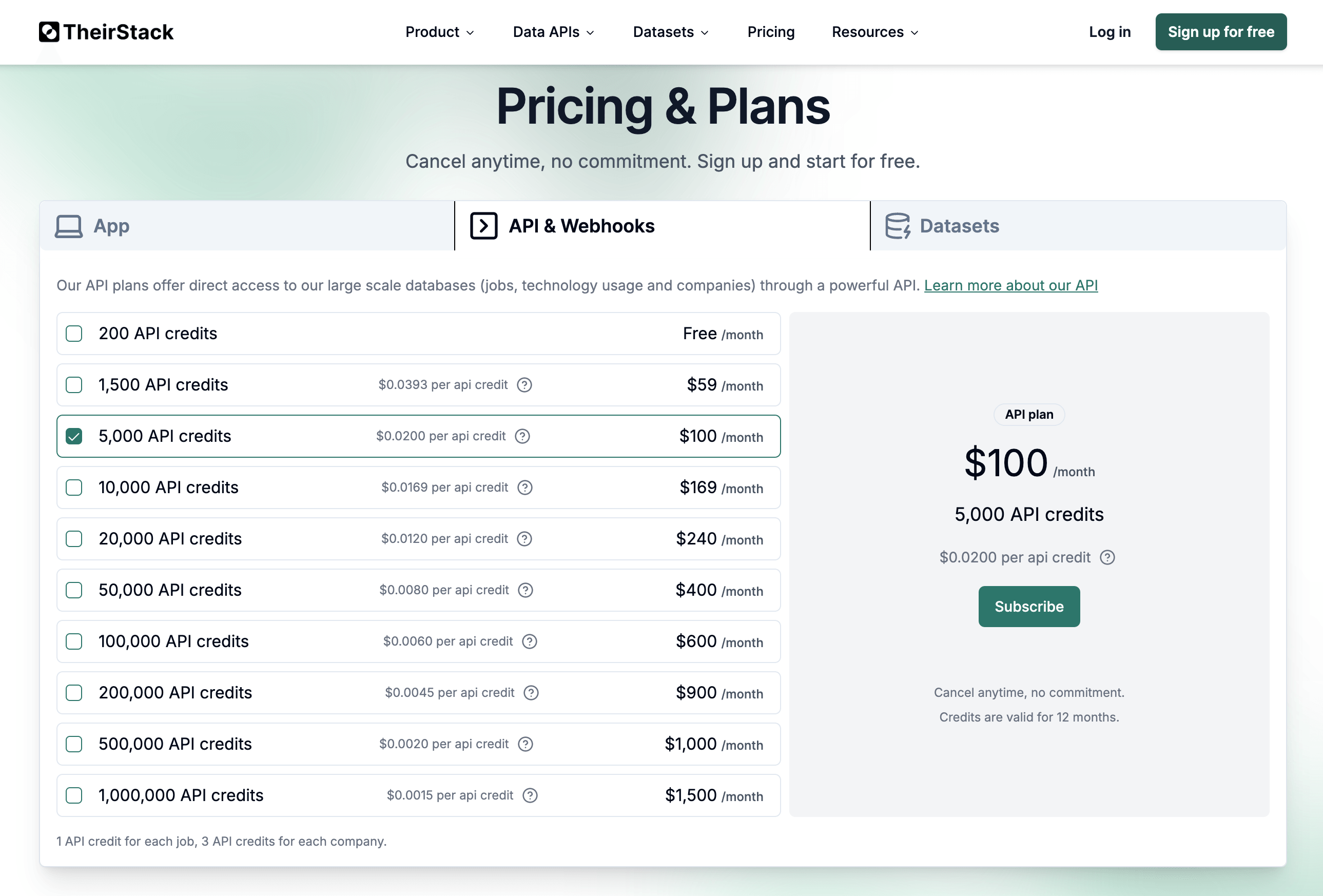
TheirStack's public pricing shows exactly what you'll pay at every level. As you scale, the cost per credit drops dramatically—down to $0.0015 per credit on our $1,500 plan. You can scale from 1,500 to 1,000,000 credits autonomously. We also offer one-time credit purchases — buy a credit pack without any subscription, and use it within 12 months.
Sumble's Pro plan (check their pricing here) provides 9900 credits for $99/month. Once you need more, there is no other option than to contact sales for an Enterprise plan.
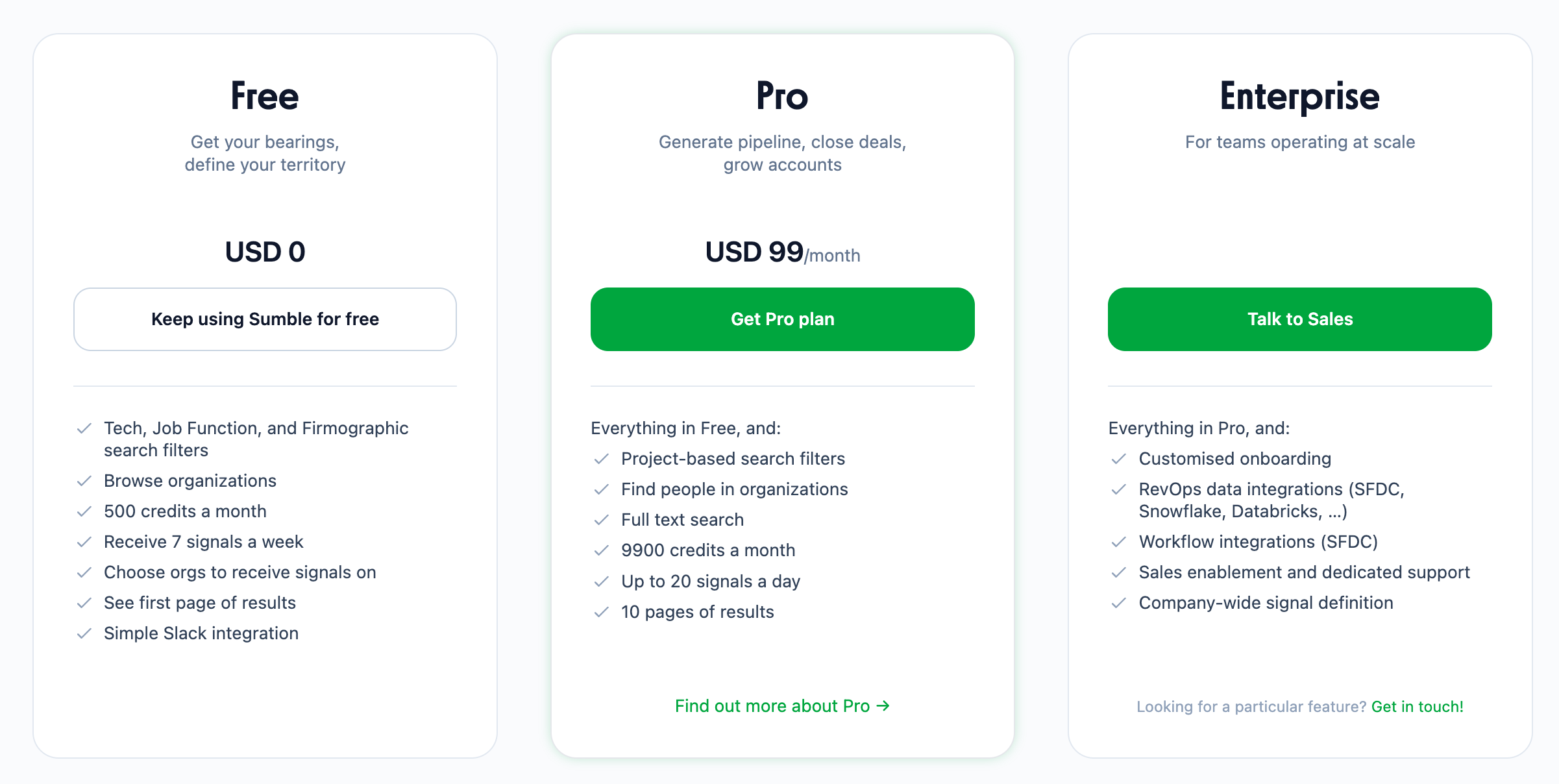
Conclusion: TheirStack wins on pricing transparency and self-serve scaling.
2. Job and Organization Costs (API Credits)
At TheirStack, a job costs exactly 1 API credit. An organization lookup costs exactly 3 API credits.
TheirStack also have webhooks, which is the equivalent of Sumble's signals. The cost of getting data via webhooks on TheirStack is the same as via API (1 job = 1 API credit, 1 company = 3 API credits). On Sumble, what you can get via signals is limited to 20/day with their Pro plan, so you can only get up to 600 signals per month.
Sumble charges 3 credits per job (~$0.03 with their Pro plan). The closest plan TheirStack has in price offers 5k API credits for $100/month. For the same monthly spend, TheirStack gives you:
- Up to 5k jobs
- Up to 1,666 companies via webhooks (what Sumble calls signals)
On the other hand, Sumble gives you:
- Up to 3.3k jobs
- Up to 600 signals (600 companies)
Conclusion: TheirStack wins on job and organization costs.
3. Technographics cost: Fixed vs. Variable
This is where the difference is most extreme.
- TheirStack: A single lookup (3 API credits) returns every technology we have ever identified for an organization, along with confidence levels and granular metrics.
- Sumble: They charge 5 credits for every single technology found.
The Price Equivalency: If you enrich an organization that uses 20 technologies:
- Sumble: 100 credits = ~$1.00
- TheirStack: 3 credits = $0.0045 – $0.11
TheirStack is up to 200x more cost-effective for technographic enrichment at scale.
Conclusion: TheirStack wins on technographics cost.
4. UI Pagination and Search Limits
Sumble's "Pro" plan caps your search results at 10 pages. TheirStack is fully usage-based and provides infinite pagination in the UI—as long as you have the credits to view the data, you can access it.
Conclusion: TheirStack wins on UI pagination and search limits.
Data Volume and Freshness
When it comes to the sheer volume of data and how quickly it's delivered, TheirStack consistently outperforms Sumble across both jobs and organization profiles.
Job Volume: 4x More Coverage
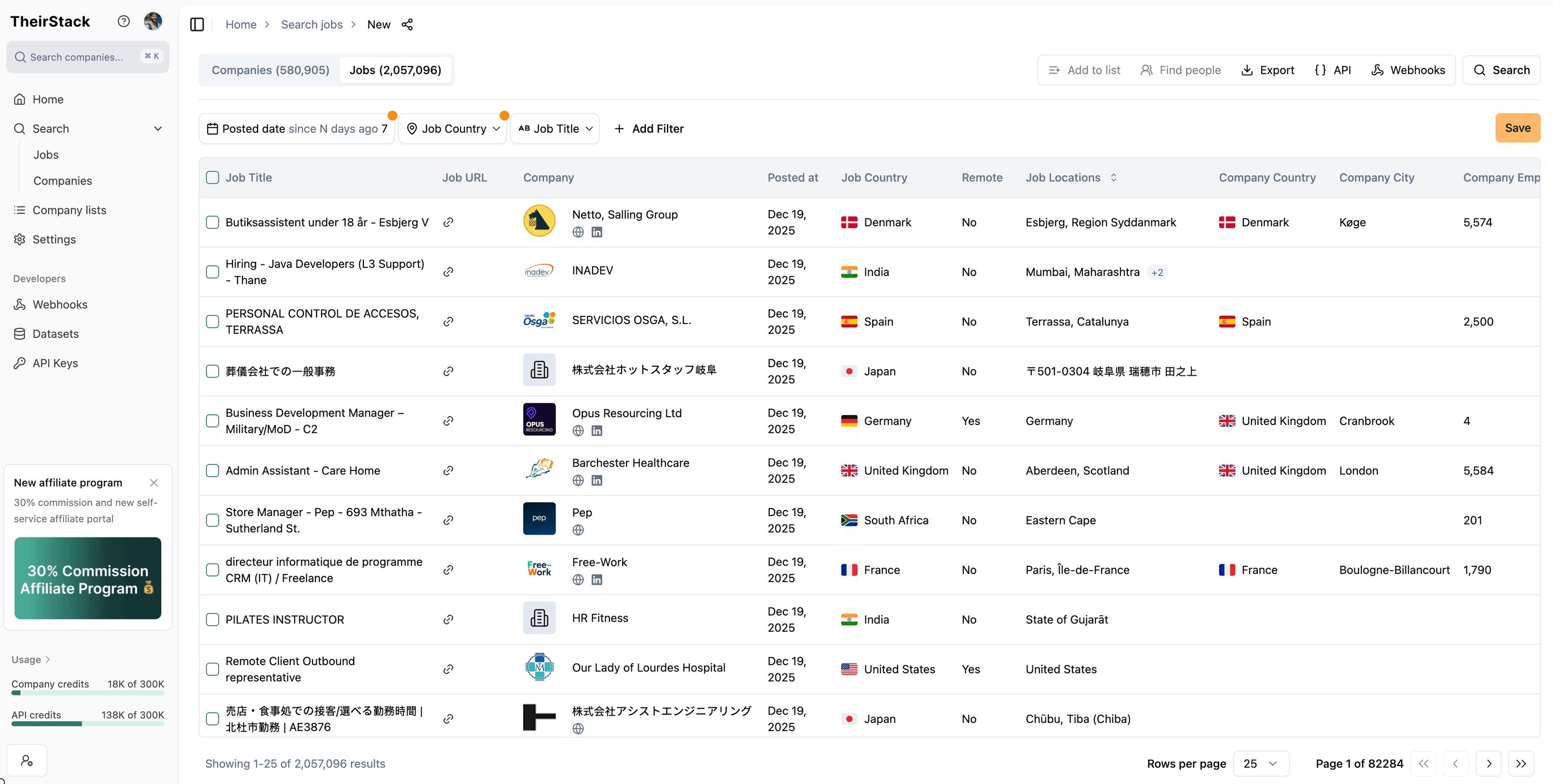 TheirStack identifies over 2.6M jobs per week, which is 10M jobs in the last 30 days. Click here to open this search on TheirStack to double-check it yourself.
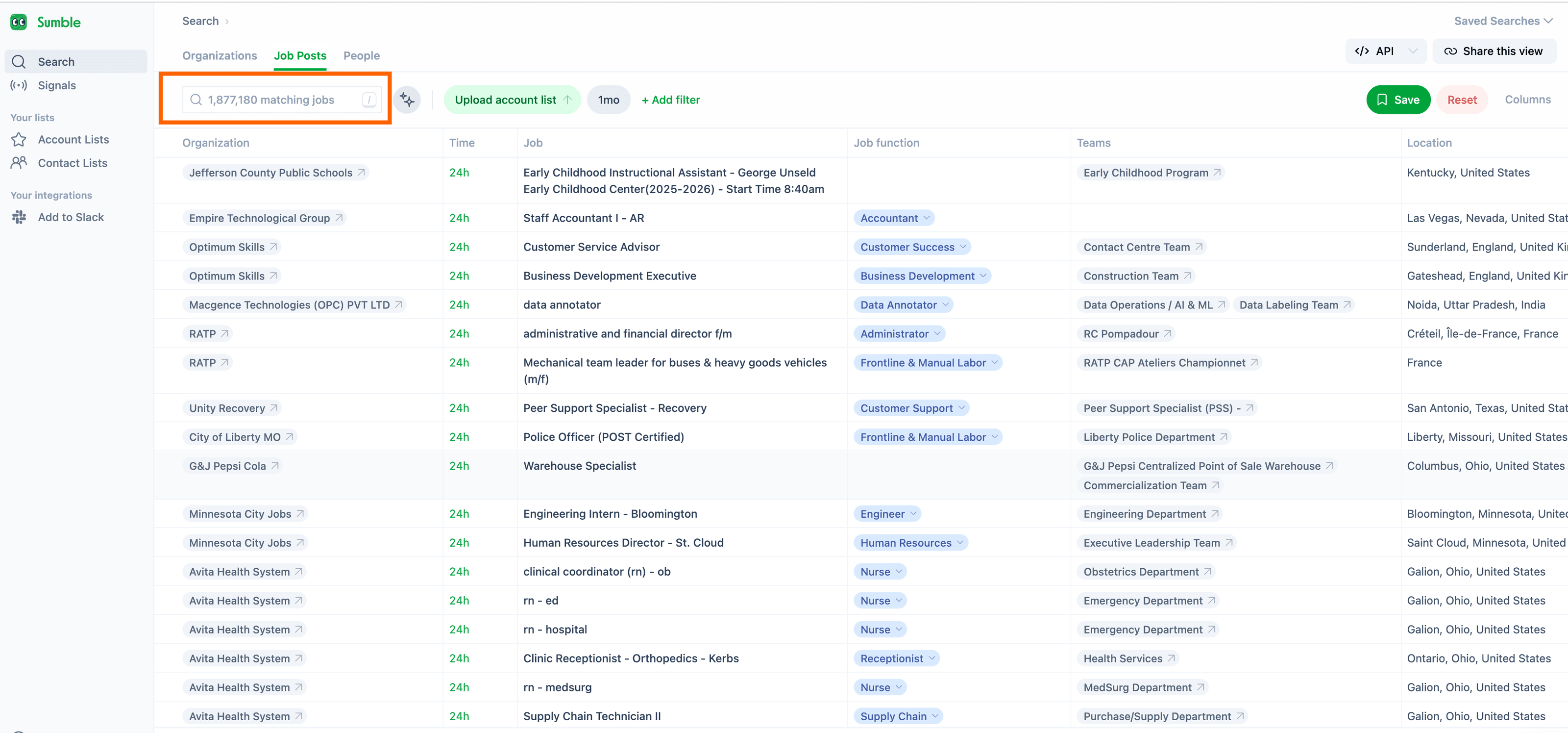 Sumble only surfaces approximately 1,800,000 jobs per month. This gives TheirStack over 4x more volume than Sumble. Double-check by going to this same search in Sumble.
Conclusion: TheirStack wins on job volume.
Job searches filtering by technology
Both TheirStack and Submle identify technology usage from mentions in job posts. So both of them should be great at being able to surface jobs that mention specific technologies. Let's see how true that is.
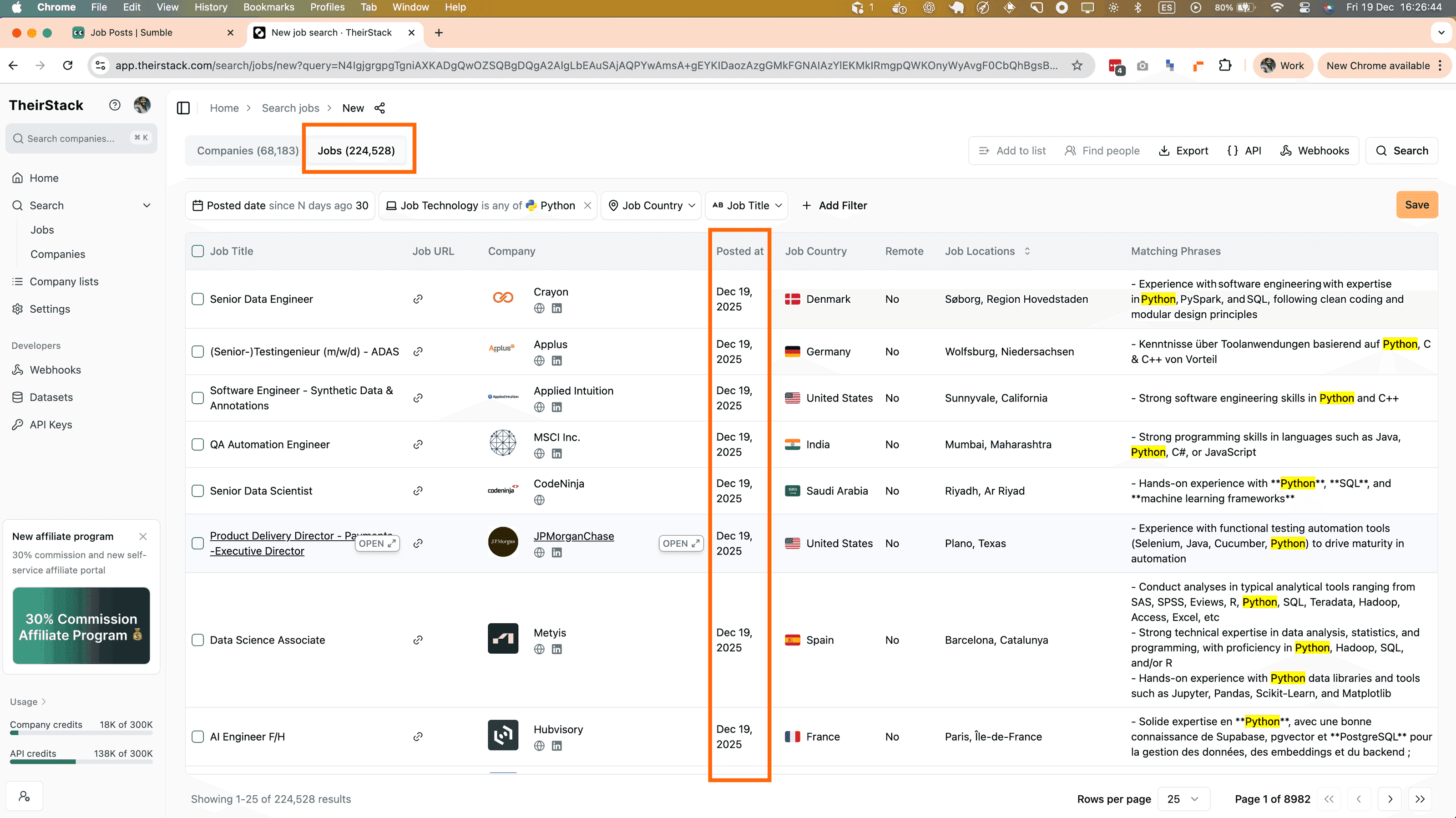
For a search like "Python jobs posted in the last 30 days", TheirStack identifies over 224,000 jobs, as seen in the folllowing screenshot. Open this search on TheirStack
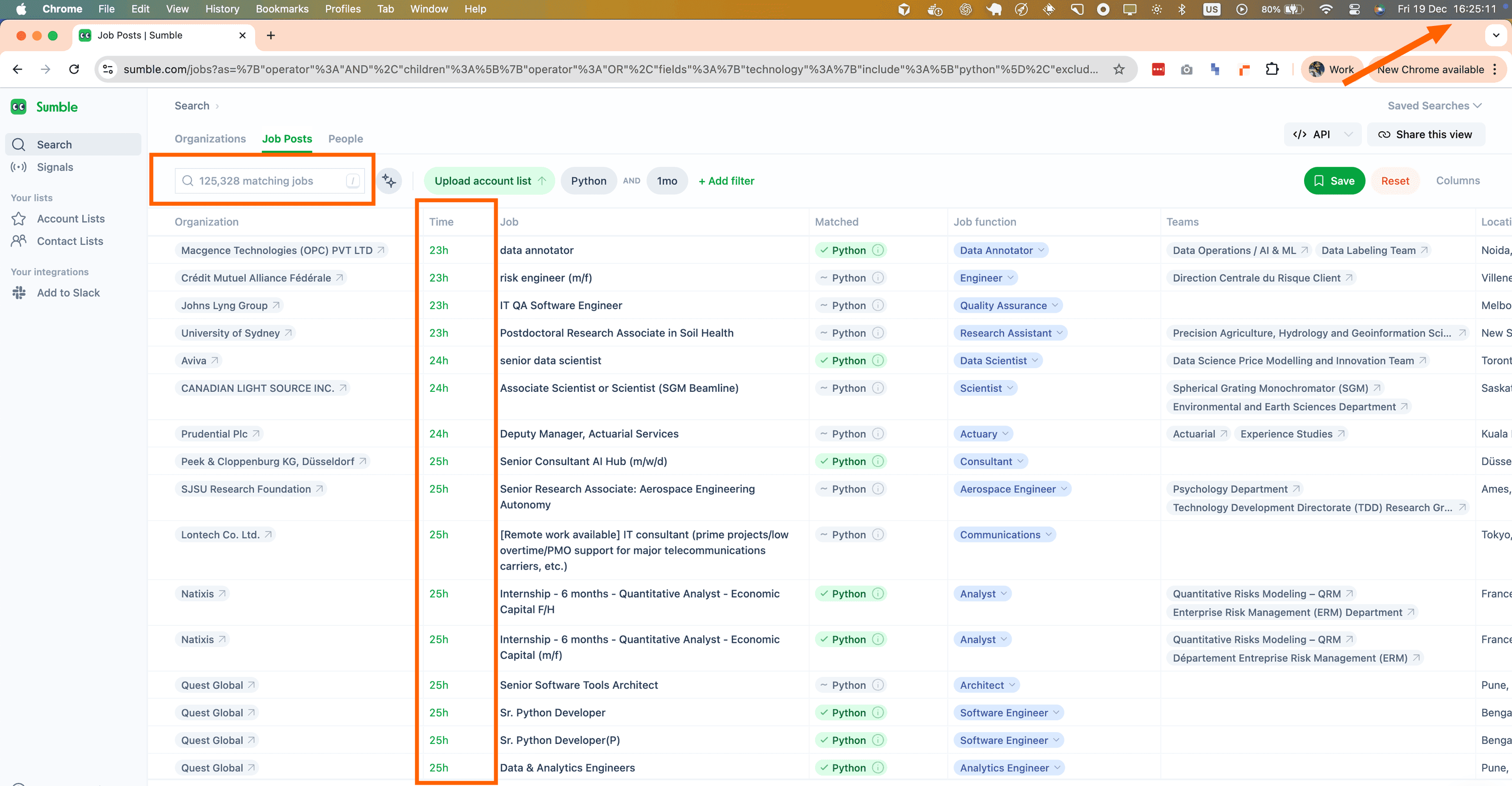
On the other hand, Sumble only yields approximately 125,000 jobs for the very same search. Open this search on Sumble
Real-time Freshness
TheirStack processes and exposes jobs in our API and UI within minutes of them being posted online.
In contrast, Sumble can take up to 24 hours to surface the same listings. See this checking the Time column of the picture above.
Conclusion: TheirStack wins on data freshness.
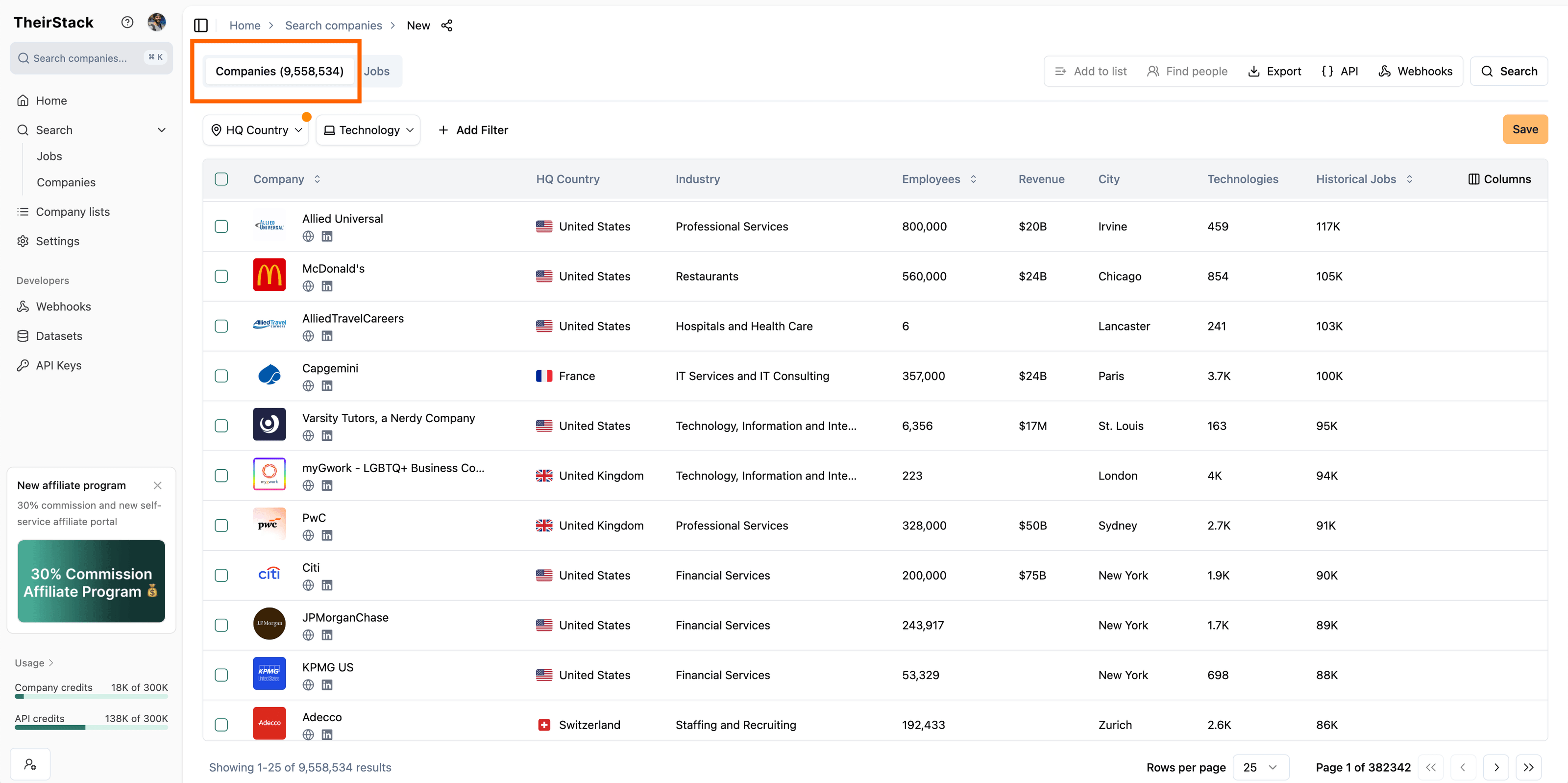
Database Scale: 9.5M vs 2.7M Organizations
-
TheirStack: Detailed data on 9.5 million organizations.
-
Sumble: Data on 2.7 million organizations.
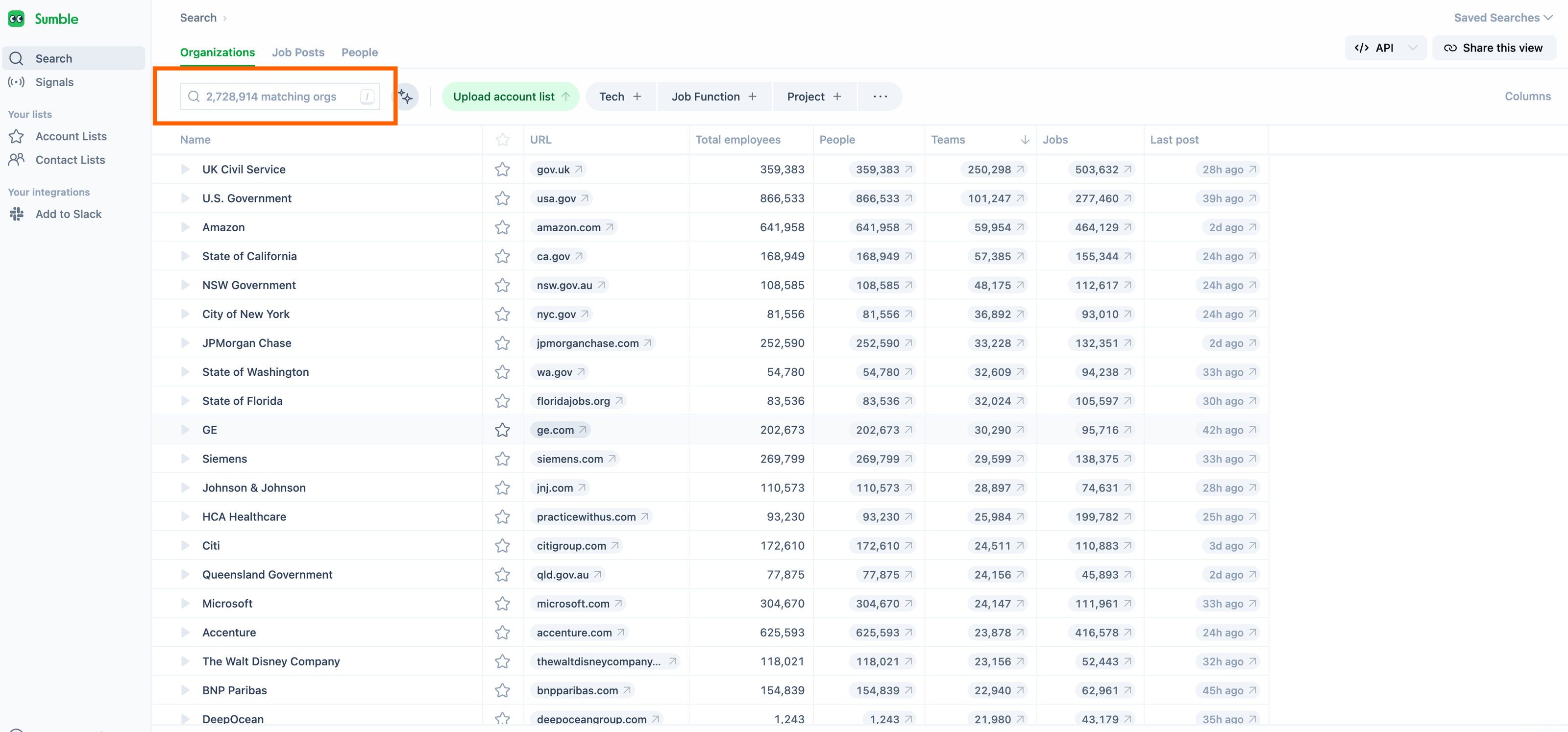
TheirStack has 3.5x more organizations in its catalog.
Conclusion: TheirStack wins on organization volume.
Data Depth and Feature Nuances
To provide an objective comparison, it's important to recognize where each platform focuses its engineering efforts. While TheirStack prioritizes the breadth and depth of job data and technographics, Sumble has invested more heavily in the "Person" and "Team" layers of sales intelligence.
Person-Level Intelligence
Sumble includes person-level data, which allows them to offer signals that TheirStack currently does not. For example, they can track when a company increases headcount in a specific area by monitoring changes in LinkedIn profiles.
If your workflow requires identifying the specific individuals currently at a company or seeing headcount trends based on existing employees, Sumble has a clear advantage here. TheirStack focuses exclusively on the "Organization" and "Job Posting" level—we tell you who they want to hire, not who they already have.
Conclusion: Sumble wins on person-level intelligence.
Team and Department Mapping
Sumble also attempts to identify and map specific teams within a company. This can be useful for seeing how an organization is structured internally. TheirStack provides granular firmographics and technographics for the organization as a whole, but we do not currently provide a structured breakdown of internal departments or teams.
Conclusion: Sumble wins on team and department mapping.
Job Title Normalization
Sumble uses machine learning to normalize job titles, which can help group similar roles together (e.g., "Software Engineer", "SWE", "Software Developer" might all map to a standardized title). TheirStack does not currently perform job title normalization—we return job titles as they appear in the original job postings.
Conclusion: Sumble wins on job title normalization.
Technology Inference: "Used" vs "Mentioned"
Sumble attempts to infer which technologies are actively used versus which are just mentioned as nice-to-haves in job descriptions. They label technologies as either TECH USED or TECH MENTIONED to help users understand what's required versus what's optional.
However, this inference is very unreliable and fails at basic logical relationships. For example, Sumble may mark a JavaScript framework like D3 or React as TECH USED while simultaneously marking JavaScript itself as only TECH MENTIONED. This is logically inconsistent—if a JavaScript framework is used, then JavaScript knowledge is absolutely required as well. The system fails to recognize these fundamental dependencies between technologies.
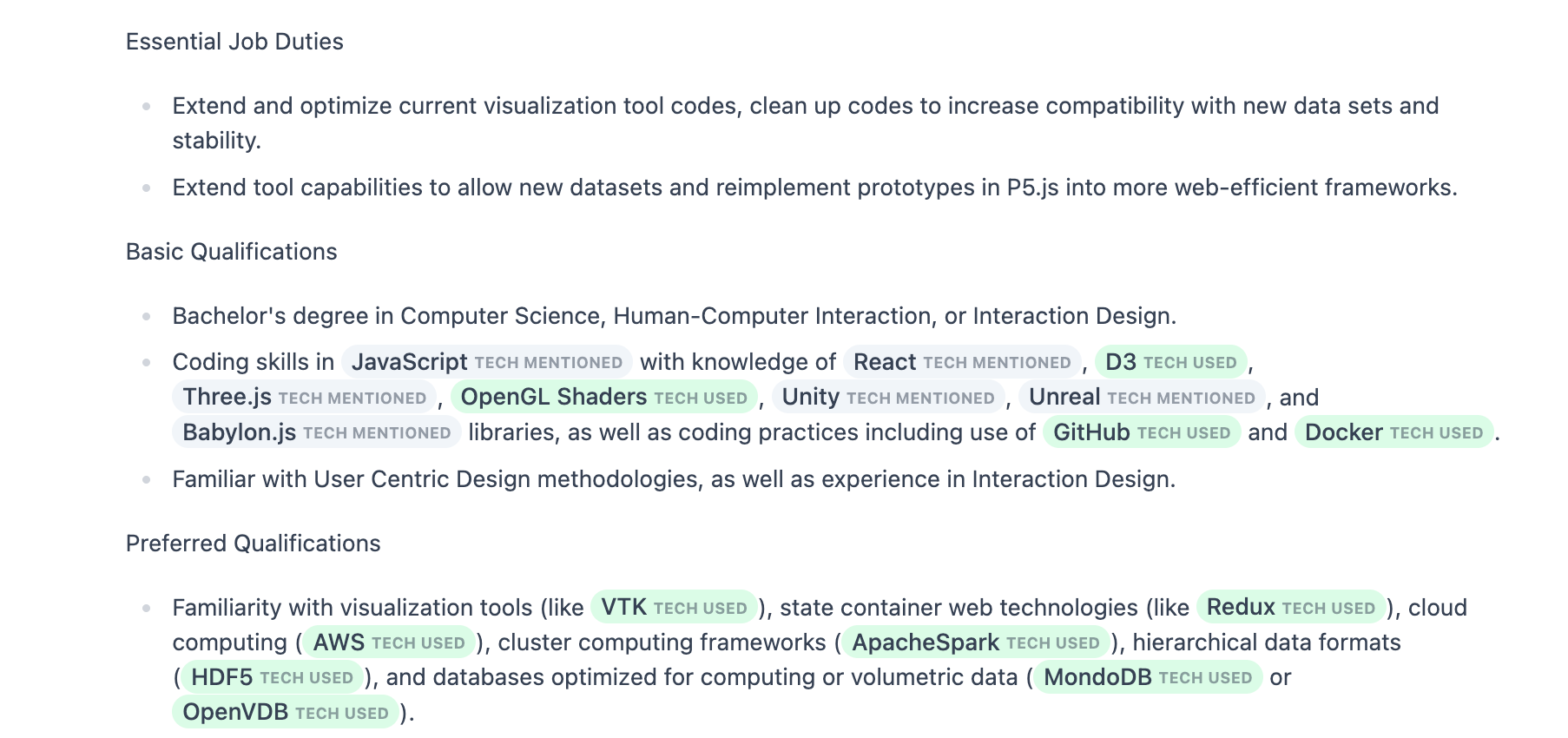
TheirStack takes a different approach: we identify all technologies mentioned in job descriptions without attempting to infer usage versus mention. We focus on doing one thing well—accurately identifying what technologies appear in job postings—rather than trying to do more and doing it inconsistently.
Conclusion: TheirStack wins on technology inference reliability.
Technology Catalog Quality
Sumble's technology catalog is derived directly from job descriptions using a Named Entity Recognition (NER) model. While this approach can capture a wide range of terms, it yields many entries that aren't actually technologies. A very large percentage of Sumble's catalog consists of "dirty" technologies—phrases like "Python Data Analytics", "Python backend", "Python software development", "Data visualization using Python", and "API/Python" that are descriptive phrases or job functions rather than actual technology names.
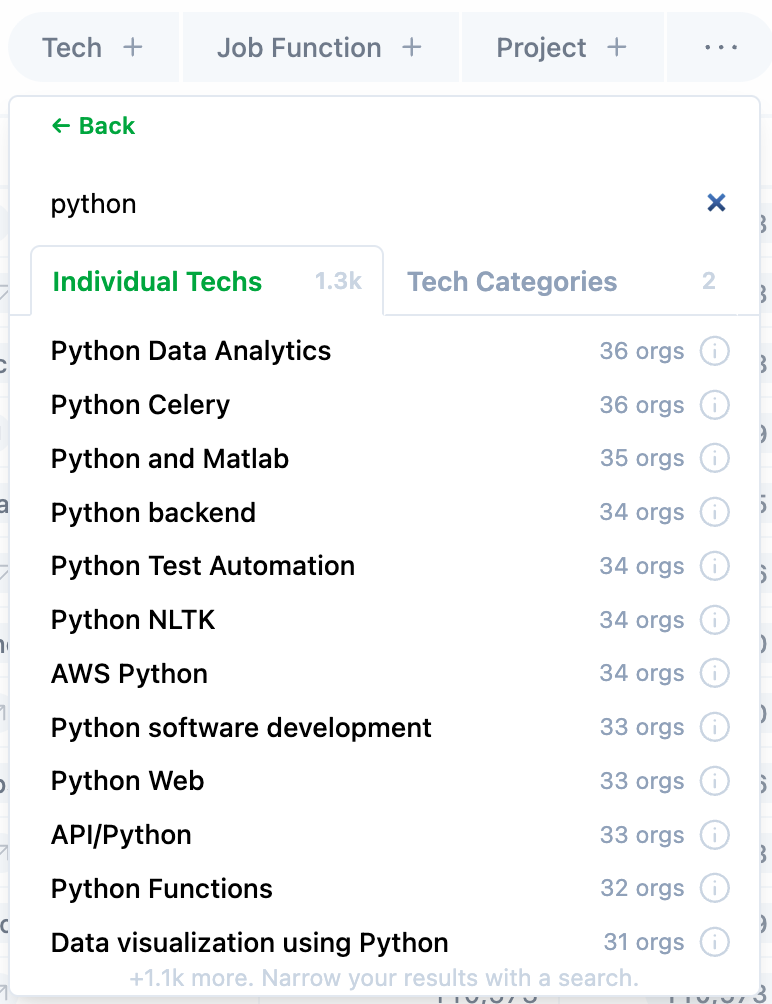
TheirStack's technology catalog is smaller and cleaner because it doesn't contain this fluff. We focus on identifying actual technologies mentioned in job postings, not extracting every phrase that happens to contain a technology keyword. This results in a more accurate, usable catalog for filtering and analysis.
Conclusion: TheirStack wins on technology catalog quality.
Organization Intelligence and Parent-Subsidiary Relationships
Founded by world-class Machine Learning experts, Sumble does a much better job at organization intelligence, particularly in identifying and mapping hierarchical organizational structures. They can accurately determine whether an organization has subsidiaries or is an independent company, and they effectively tie together organizations under the same parent organization.
For example, Sumble can display complex hierarchies like "U.S. Government" → "US Department of Energy" → "Lawrence Berkeley National Laboratory" → "Cyclotron" with clear parent-child relationships. This hierarchical view helps users understand organizational structures and relationships at a glance.
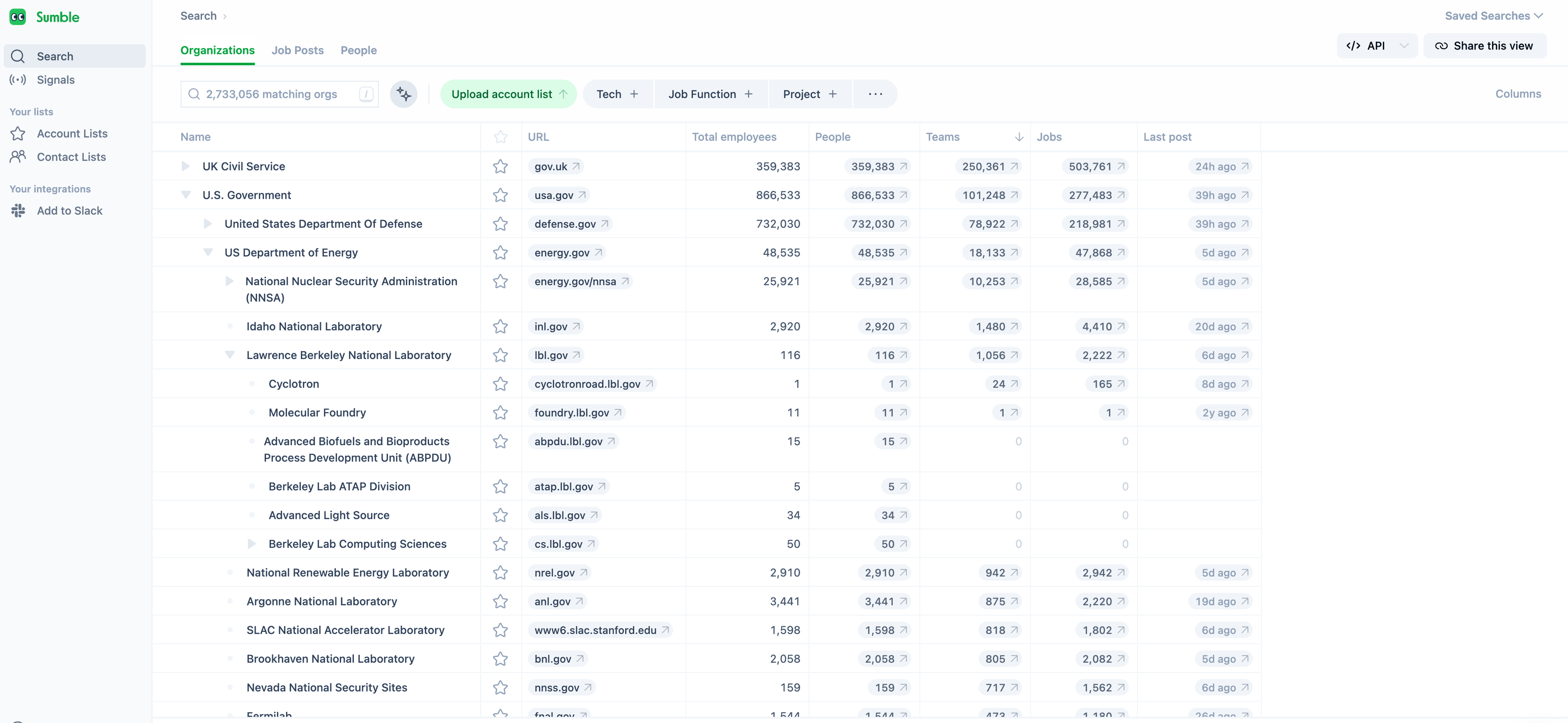
TheirStack treats organizations more independently and does not currently provide the same level of parent-subsidiary relationship mapping or hierarchical organization intelligence.
Conclusion: Sumble wins on organization intelligence and parent-subsidiary relationships.
API Documentation and Filtering Capabilities
Developer Experience: Clear Documentation vs. Limited Docs
TheirStack's Job Search API documentation is comprehensive, self-serve, and includes examples for every parameter. You can test endpoints directly in the browser.
Sumble's API documentation is more limited. While functional, it lacks the depth and clarity needed for complex integrations. Understanding parameter usage often requires trial and error or reaching out to support.
Sumble offers an "advanced query" option that allows filtering by fields like job_function or hiring_period, but these parameters are not documented in their public API reference. This undocumented functionality requires developers to discover features through experimentation or support conversations.
Filter Depth: 40+ vs. 7 Filters
This is where the gap becomes most apparent for developers building sophisticated search workflows.
TheirStack's Job Search API offers 40+ filters across multiple categories:
- Job-level filters: Title (with regex support), description patterns, location patterns, salary ranges, seniority, remote options, posted date ranges, and more.
- Company-level filters: Industry, size, country, revenue, funding, URL patterns, LinkedIn URL, and more.
- Technology filters: Filter by technologies mentioned in job descriptions.
- Advanced features: Regex support for many text fields, exclusion filters, and complex boolean logic.
Sumble's Jobs API offers just 7 filters according to their public documentation:
- Company filters (domain, ID, slug)
- Technology filters
- Technology category filters
- Country filters
- Date filters (
since)
Notably, Sumble's API doesn't even support filtering by job title according to their public documentation. This is a fundamental limitation for many use cases where you need to find specific roles (e.g., "Data Engineer" or "DevOps Manager").
If you need to build sophisticated search workflows—like finding "Python jobs in New York posted in the last 7 days for companies with 50-200 employees"—TheirStack's extensive filtering capabilities support this use case.
Conclusion: TheirStack wins on developer experience.
Quick Decision Guide
Choose TheirStack if
- ✓You care about overall cost—TheirStack offers significantly lower costs per job, organization, and technographic enrichment.
- ✓You need high volume—10M jobs in the last 30 days vs 1.8M.
- ✓You need real-time data—jobs available within minutes vs up to 24 hours.
- ✓You need advanced API filters—40+ filters including regex support vs 7 basic filters.
- ✓You want transparent, self-serve pricing—scale autonomously without sales calls. One-time purchases also available, no subscription required.
- ✓You need technographics at fixed cost—all technologies included vs pay-per-technology.
- ✓You want a clean technology catalog—actual technologies only, not descriptive phrases or job functions.
- ✓You want original job URLs to verify sources or repost jobs.
- ✓You need a larger organization database—9.5M organizations vs 2.7M.
- ✓You prefer clear, comprehensive API documentation with self-serve examples.
Choose Sumble if
- ✓You need signals based on new hires or growth in headcount—Sumble tracks changes in LinkedIn profiles to identify headcount trends.
- ✓You need person-level LinkedIn data—identify specific individuals currently at companies.
- ✓You need team/department mapping—see how organizations are structured internally.
- ✓You need organization intelligence and parent-subsidiary relationships—understand hierarchical org structures and identify which companies are subsidiaries vs independent.
- ✓You need ML-based job title normalization—group similar roles together (e.g., "Software Engineer", "SWE", "Software Developer").
- ✓You only need basic search and don't mind a 10-page limit on results.
- ✓You are okay with a sales-led process for higher volume needs.
Summary
TheirStack offers significantly lower costs (up to 200x more cost-effective for technographics), higher job volume (10M jobs in the last 30 days vs 1.8M per month), real-time freshness (minutes vs 24 hours), 40+ API filters, reliable technology identification, a clean technology catalog, and a larger organization database (9.5M vs 2.7M). Sumble provides person-level intelligence, team mapping, organization intelligence with parent-subsidiary relationships, job title normalization, and signals based on new hires or headcount growth that TheirStack does not currently support.