Product updates

All the latest updates, improvements, and fixes to TheirStack

February 2, 2026

Search within your Company Lists

Search within your Company Lists

The problem: When you save companies to a list after searching by job title or technology, the list only shows basic company information. You lose the job and technology context that made those companies relevant in the first place — and exports don't include those fields either.

The solution: You can now click the "Add filter" button next to the search bar on any company list page.

This opens the company search with your list pre-selected as a filter, where you can:

  • Re-apply job title or description filters to see matching jobs
  • Add technology filters to see which tools each company uses
  • Export results with job titles, technologies, and other fields included

Step 2: Company search with your list filter applied

This bridges the gap between your curated company lists and TheirStack's full search capabilities — so you never lose the context of why a company was added to your list.

January 19, 2026

Increased amount of discovered jobs

Increased amount of discovered jobs

Since November we've constantly increased the number of daily jobs in our system by scaling up our discovery agents and improving how we find new job postings.

We now have more agents scanning job boards, so we're catching jobs faster and more frequently. We've also improved our discovery strategy to find a wider variety of job types, job roles and jobs in countries that we might have missed before.

What this means for you:

  • More hits on your job searches: Your searches will return more results
  • More jobs for each company: Companies now have more job postings in our system
  • More technology hits: When searching for jobs or companies using specific technologies, you'll find more matches

These improvements are live now. You'll see more jobs in your searches and exports as we continue discovering new postings every day.

January 15, 2026

New technologies added

We've added 24 new technologies to our detection system, expanding coverage across artificial intelligence models, accounting software, meeting tools, and development platforms.

Artificial Intelligence & Machine Learning

Accounting & Financial Management

Meeting & Collaboration Tools

Development & Testing

Other Categories

December 19, 2025

Full locations catalog now searchable - over 4.2M locations available

We've expanded the locations catalog endpoint to include the full catalog of over 4.2 million searchable locations, up from the previous limit of 250,000 locations.

What's changed

When we first introduced the locations catalog alongside the new location filters, we initially limited searchable locations to 250k to ensure fast response times. Now, you can search through and use the complete catalog of over 4.2 million locations in your job searches.

This means you can now find and use location IDs for:

  • More cities and towns - Access to smaller cities, towns, and localities that weren't previously searchable
  • Broader geographic coverage - More comprehensive location data across all countries and regions
  • Greater precision - Find exact location IDs for even the most specific geographic areas

All locations in the catalog can be used with the job_location_or and job_location_not filters in the Jobs Search API and the New Job Location filter in the UI, giving you access to the full breadth of our location data for precise geographic targeting.

December 18, 2025

More accurate job location filtering - 20% fewer false matches

We've significantly improved the accuracy of the job_location_or filter (shown as "New Job Location" in the UI) reducing false positives in location matching by ~20%.

Before

When looking for jobs from many cities, around 20% of the results were false positives. For example, when looking for jobs from Manchester, one would get results from different places as shown in the image below:

Before

After

This happened because for jobs where we didn't have structured location data but just a location string, we'd fall back to making string matches on the name of the location being searched, as well as it's parent administrative units (state, country, etc.). So we'd be looking for jobs mentioning 'England' as well, which would yield many false positives.

This is now fixed and in the following image you can see that both the number of jobs found is lower, and there are no false positives anymore:

After

November 17, 2025

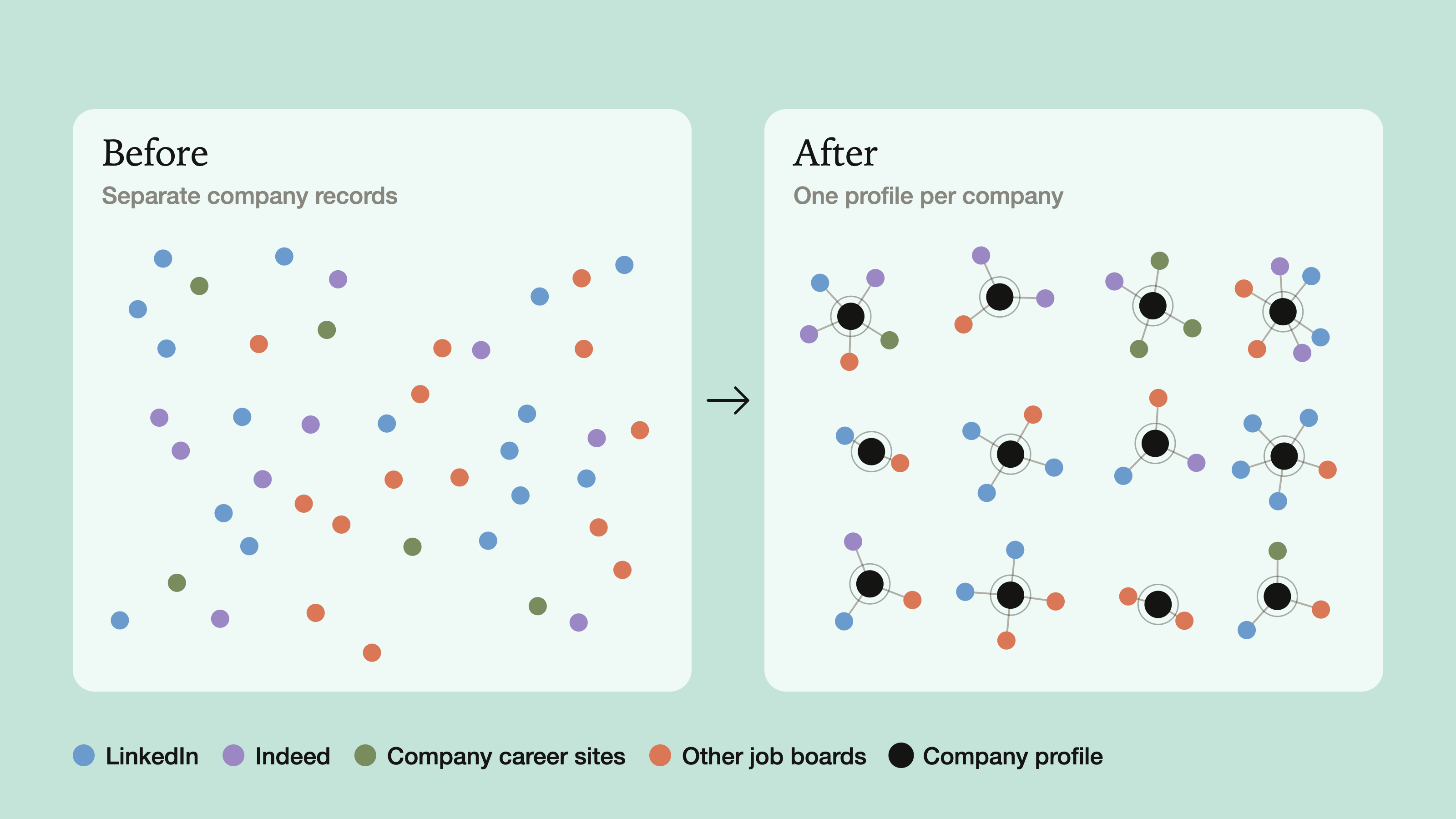
Smarter company matching using multiple data points

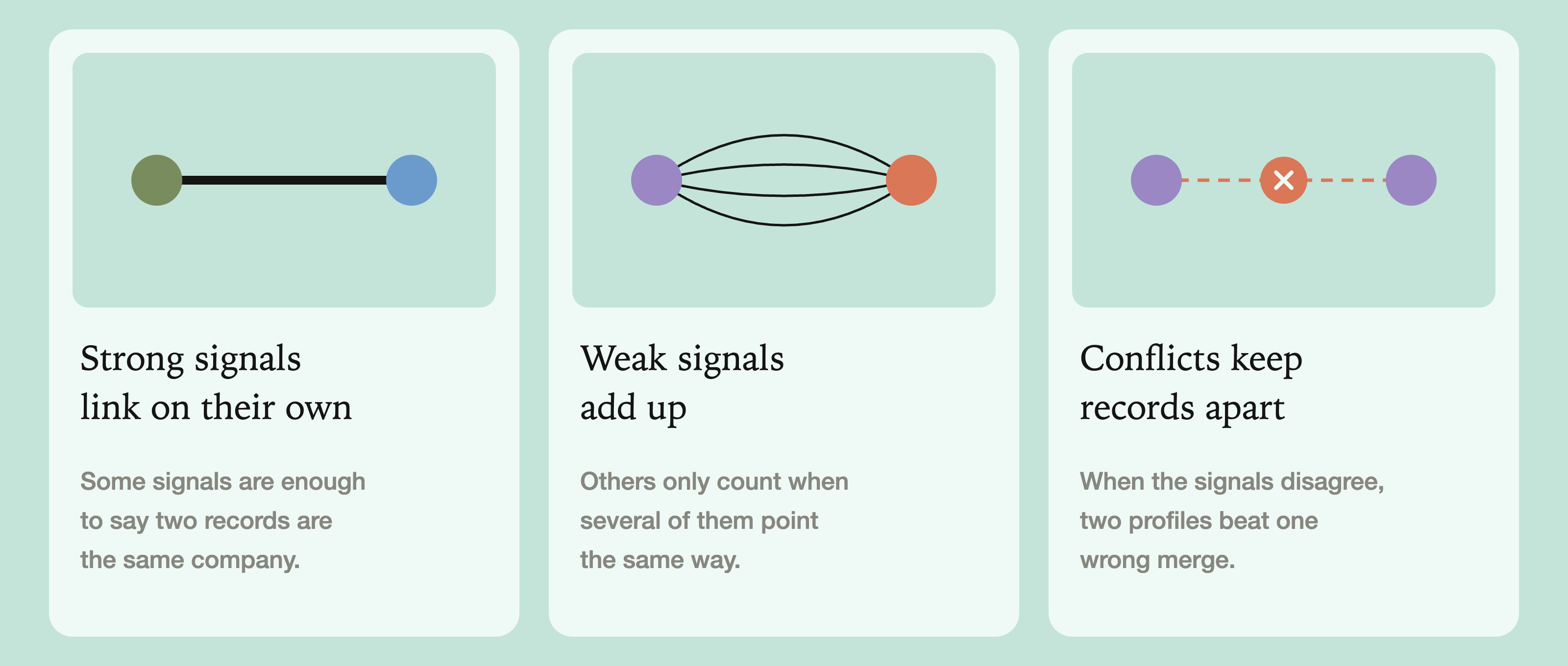
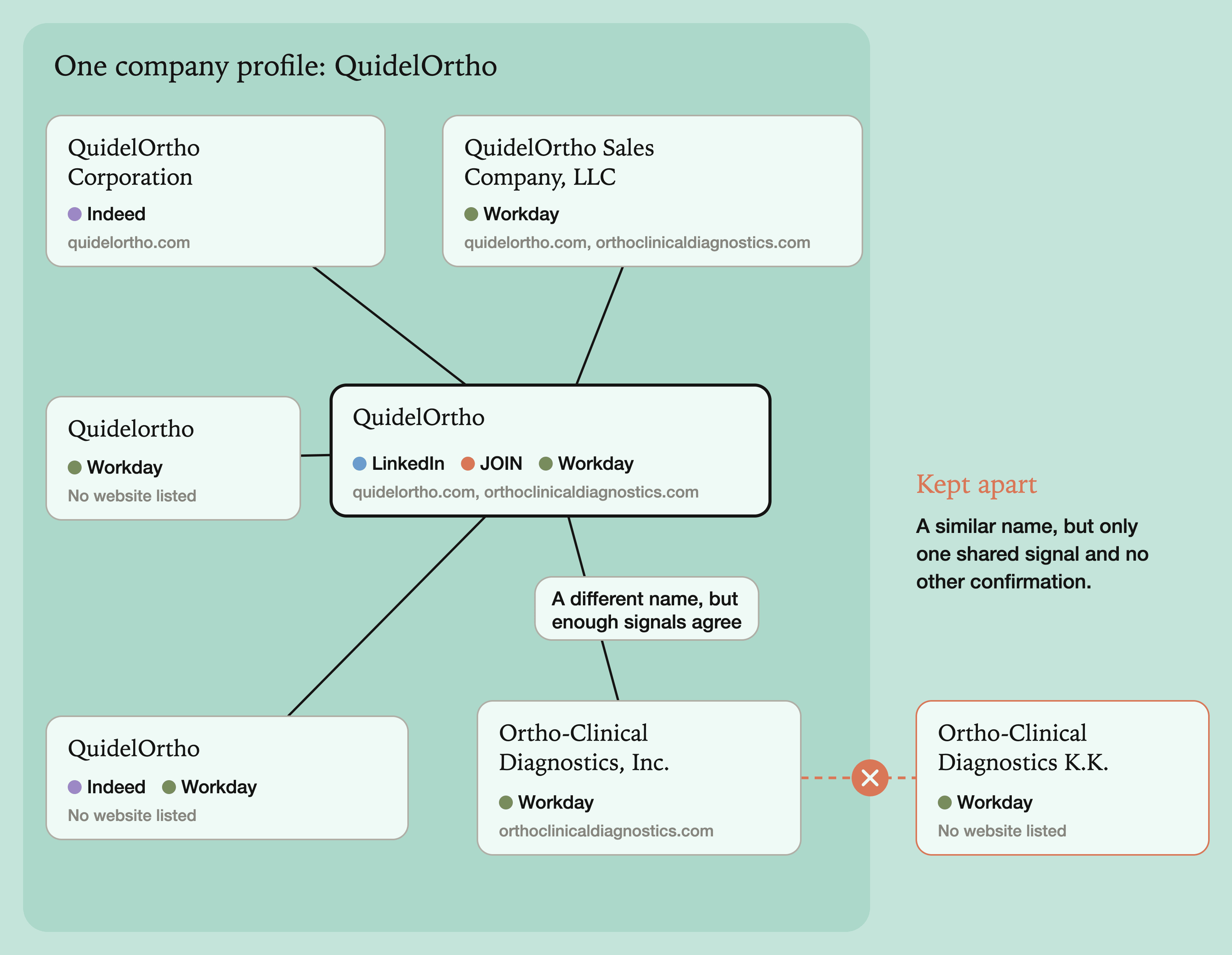
We've fixed an issue where jobs weren't always matched to the correct company. When multiple companies had the same name, our system couldn't tell them apart reliably.

Now our matching algorithm uses the job's company domain and source as additional signals to identify the right company. This means each job gets linked to the correct company profile, even when company names are identical.

All new jobs posted from November 17, 2025 onward use this improved matching. We're also updating existing jobs over the next few weeks so they benefit from the same enhancement.

November 10, 2025

November 3, 2025

New columns when exporting jobs

We've added two new columns to job exports from the Job Search feature. These columns help you filter and analyze jobs more effectively when exporting your results.

The new columns are:

  • employment_status - Displays the employment statuses for the job. This can include values like "Full-time", "Part-time", "Contract", or "Temporary". When a job has multiple statuses, they're listed as a comma-separated string.

  • seniority - Indicates the seniority level of the position. This field uses values like c_level, staff, senior, mid_level, or junior to help you categorize roles by experience level.

These columns are automatically included in all job exports (CSV and Excel formats), so you'll have richer data to work with when analyzing job postings or building integrations.

Rate Limit Headers

We've added rate limit information to API response headers, making it easier to monitor your usage and manage your API integrations.

Every API response now includes these headers:

  • RateLimit - Current quota status per policy with remaining requests and reset time
  • RateLimit-Policy - Applied policy definitions with limits and window durations
  • RateLimit-Remaining - Shows how many requests you have left in each time window
  • RateLimit-Reset - Tells you when each limit resets (in seconds)
  • RateLimit-Limit - Your total allowed requests per window

For complete details on which headers are included, what they mean, and how to use them, check out our API documentation. The rate limiting section explains everything you need to know about rate limits and how to handle them in your applications.

October 31, 2025

October 24, 2025

Clay Integration

We're excited to announce that TheirStack Jobs Data is now available as an integration in Clay, giving you access to real-time job posting data directly within your GTM workflows.

How to Use

To get started with the TheirStack integration in Clay:

  1. Go to Clay and create a new table.
  2. Go to "Add Enrichment" in your Clay table
  3. Select "TheirStack" from the integrations list
  4. Choose "Get Company Jobs" to retrieve job postings

For more information about our job data, check out our Job Search API documentation. You can also learn more about the integration on Clay's TheirStack integration page or read about it in Clay's product roundup changelog.