New technologies added
We've added 25 new technologies to our detection system, expanding coverage across sales tooling, marketing and growth platforms, finance and billing software, and development infrastructure.
All the latest updates, improvements, and fixes to TheirStack
We've added 25 new technologies to our detection system, expanding coverage across sales tooling, marketing and growth platforms, finance and billing software, and development infrastructure.
We've updated our technology signals to automatically exclude recruiting agencies, staffing companies, and other firms that repost job offers on behalf of other companies.
Previously, results sometimes included companies that didn't provide meaningful value—firms that repost job offers for other companies rather than using the technologies themselves. This reduced the quality and relevance of your search results.
Now, when you search for companies using technology signals (technographics), you'll only see direct employers—companies that post jobs for their own positions.
This filtering happens automatically in all technology signal searches, so you don't need to do anything differently.
We'll continue making improvements to maintain and enhance the accuracy and reliability of our data to deliver a better experience for all users.
You can now connect AI assistants like Claude, Cursor, or ChatGPT to TheirStack using the Model Context Protocol (MCP).
Ask your AI assistant questions in natural language and it will query TheirStack's data directly — no copy-pasting, no code needed.
Add TheirStack's MCP server to your client with your API key. Setup takes under a minute — see the full documentation for Cursor, Claude Code, Claude Desktop, Windsurf, and other clients.
MCP requests consume API credits at the same rate as regular API calls.
The problem: When you open a company profile to check its tech stack, you have to manually search through dozens of technologies to find the ones you care about. Every time, the same repetitive filtering.
The solution: You can now mark technologies as favourites. Starred technologies appear first everywhere — in company profiles and in search filters.
Open any company profile, search for a technology, and click the star icon to add it to your favourites.
From now on, when you open any company profile, your favourites appear at the top — so you can instantly check if a company uses the tools you're tracking. If a favourite technology is not detected for that company, it will still show up in the starred section marked as unknown, confirming the company is not using it.
You can also manage your favourite technologies from Settings → Preferences at any time.
Your favourites also appear at the top of the technology filter in company search, making it faster to build searches around the technologies you track most.
The problem: When you save companies to a list after searching by job title or technology, the list only shows basic company information. You lose the job and technology context that made those companies relevant in the first place — and exports don't include those fields either.
The solution: You can now click the "Add filter" button next to the search bar on any company list page.
This opens the company search with your list pre-selected as a filter, where you can:
This bridges the gap between your curated company lists and TheirStack's full search capabilities — so you never lose the context of why a company was added to your list.
Since November we've constantly increased the number of daily jobs in our system by scaling up our discovery agents and improving how we find new job postings.
We now have more agents scanning job boards, so we're catching jobs faster and more frequently. We've also improved our discovery strategy to find a wider variety of job types, job roles and jobs in countries that we might have missed before.
These improvements are live now. You'll see more jobs in your searches and exports as we continue discovering new postings every day.
We've added 24 new technologies to our detection system, expanding coverage across artificial intelligence models, accounting software, meeting tools, and development platforms.
We've expanded the locations catalog endpoint to include the full catalog of over 4.2 million searchable locations, up from the previous limit of 250,000 locations.
When we first introduced the locations catalog alongside the new location filters, we initially limited searchable locations to 250k to ensure fast response times. Now, you can search through and use the complete catalog of over 4.2 million locations in your job searches.
This means you can now find and use location IDs for:
All locations in the catalog can be used with the job_location_or and job_location_not filters in the Jobs Search API and the New Job Location filter in the UI, giving you access to the full breadth of our location data for precise geographic targeting.
We've significantly improved the accuracy of the job_location_or filter (shown as "New Job Location" in the UI) reducing false positives in location matching by ~20%.
When looking for jobs from many cities, around 20% of the results were false positives. For example, when looking for jobs from Manchester, one would get results from different places as shown in the image below:

This happened because for jobs where we didn't have structured location data but just a location string, we'd fall back to making string matches on the name of the location being searched, as well as it's parent administrative units (state, country, etc.). So we'd be looking for jobs mentioning 'England' as well, which would yield many false positives.
This is now fixed and in the following image you can see that both the number of jobs found is lower, and there are no false positives anymore:

We've fixed an issue where jobs weren't always matched to the correct company. When multiple companies had the same name, our system couldn't tell them apart reliably.
Now our matching algorithm uses the job's company domain and source as additional signals to identify the right company. This means each job gets linked to the correct company profile, even when company names are identical.
All new jobs posted from November 17, 2025 onward use this improved matching. We're also updating existing jobs over the next few weeks so they benefit from the same enhancement.
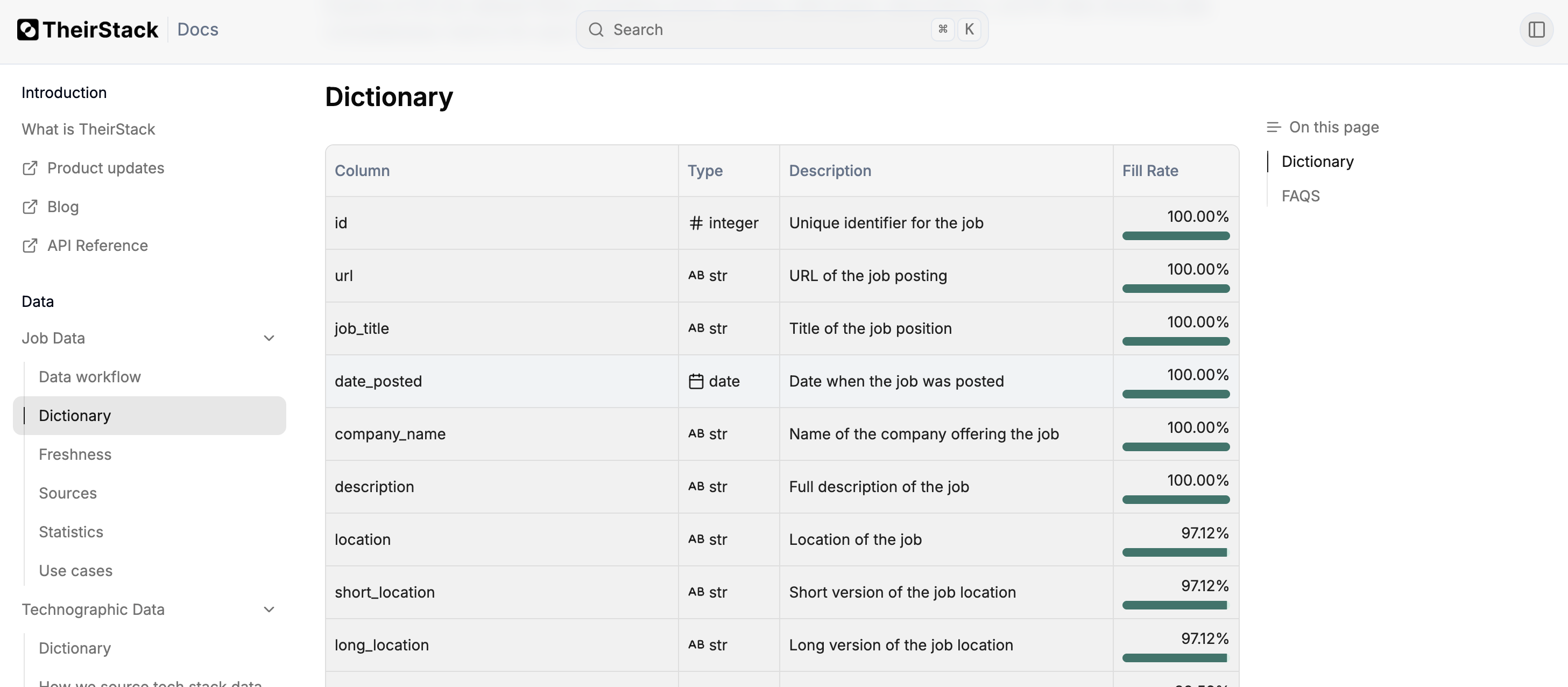
You can now see the fill rate for every field across our main entities: Job, Company, Technographic, and Technology.
Fill rate shows what percentage of records have a value for each field. We update this metric in real time, so you'll always see the latest data coverage.
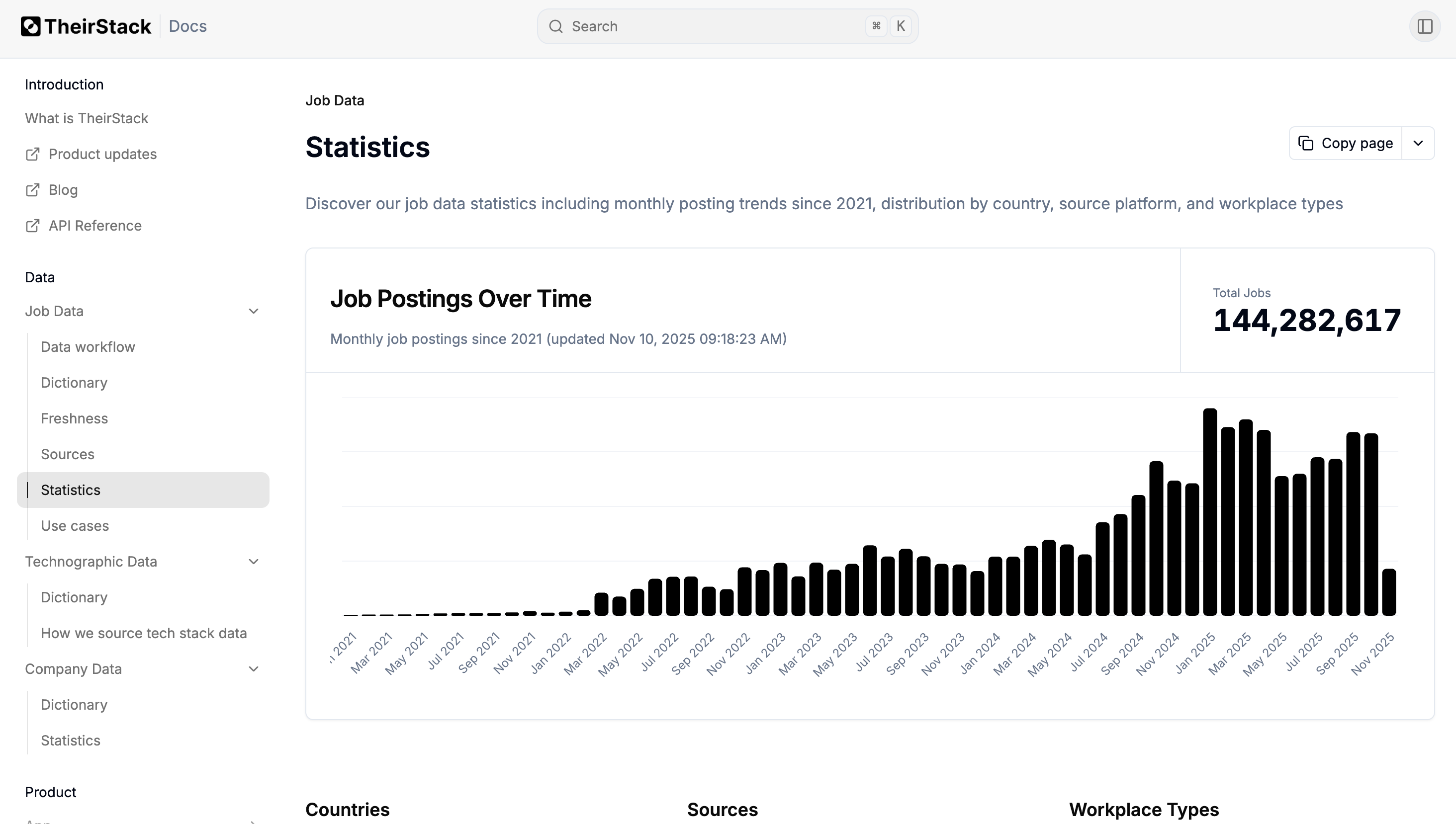
We've added a new Jobs Statistics page where you can see the total number of jobs discovered each month. You'll also find breakdowns by country, source, and workplace type.
We've also created a Companies Statistics page with breakdowns by industry, employee size, and headquarters country.