Salary benchmarking with job postings works when you pull every posting for one role segment, keep the ones that publish pay, read that pay as annual USD and take the median by place and level. We ran it for software engineers on 10 November 2026. Over the last 30 days, direct employers posted 21,782 open software engineer jobs in the US, and 9,361 of them (43%) published a salary. Half of those salaried postings start at $140,000 a year or more, and half top out at $200,000 or less.
The volume count includes matching postings without salary, and the medians describe only those that publish pay. That share swings from 43% in the US to under 5% in India. Below are the numbers by country and seniority, the method, and where the data stops being safe to count.
What do US software engineer job postings pay in November 2026?
US software engineer postings from direct employers put the middle of the posted range at about $140,000 for the lower bound and about $200,000 for the upper bound. Those two medians come from 9,361 open postings with salary, published by 2,684 companies between 11 October and 10 November 2026.
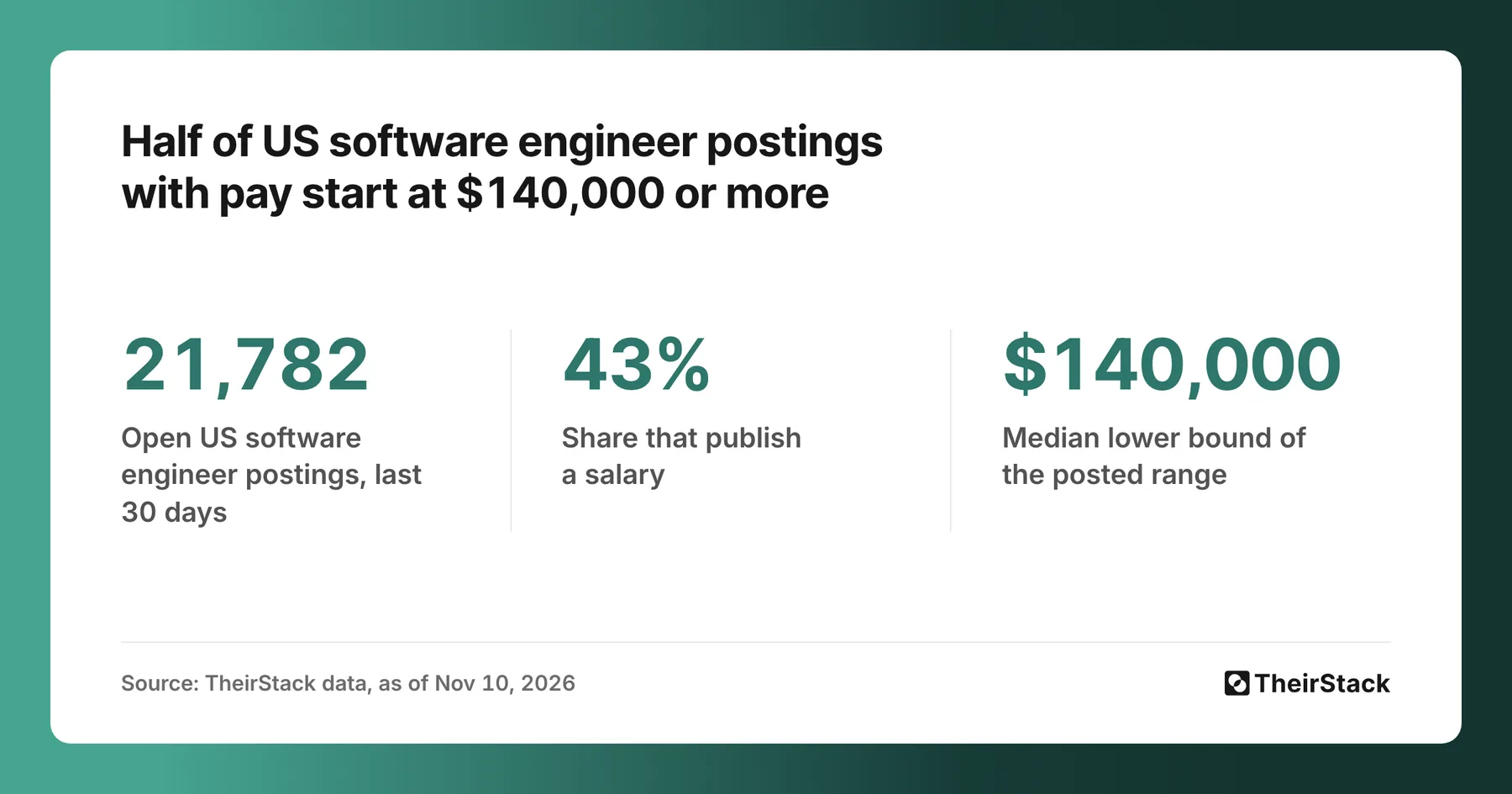 Half of US software engineer postings with pay start at $140,000 or more
The figure shows the three numbers the benchmark rests on, which are the postings counted, the share with pay, and the median of the lower end of the posted range.
Outliers barely move these numbers. Only 6 of the 9,361 salaried postings list an upper bound above $1,000,000 a year, so a median that ignores them and one that keeps them land in the same place.
How do posted salaries compare across the US, UK, Canada, Germany and India?
The US is the only one of these five markets where a salary median rests on thousands of postings. Canada and the UK carry a usable but small sample, and Germany and India publish pay on too few postings to benchmark.
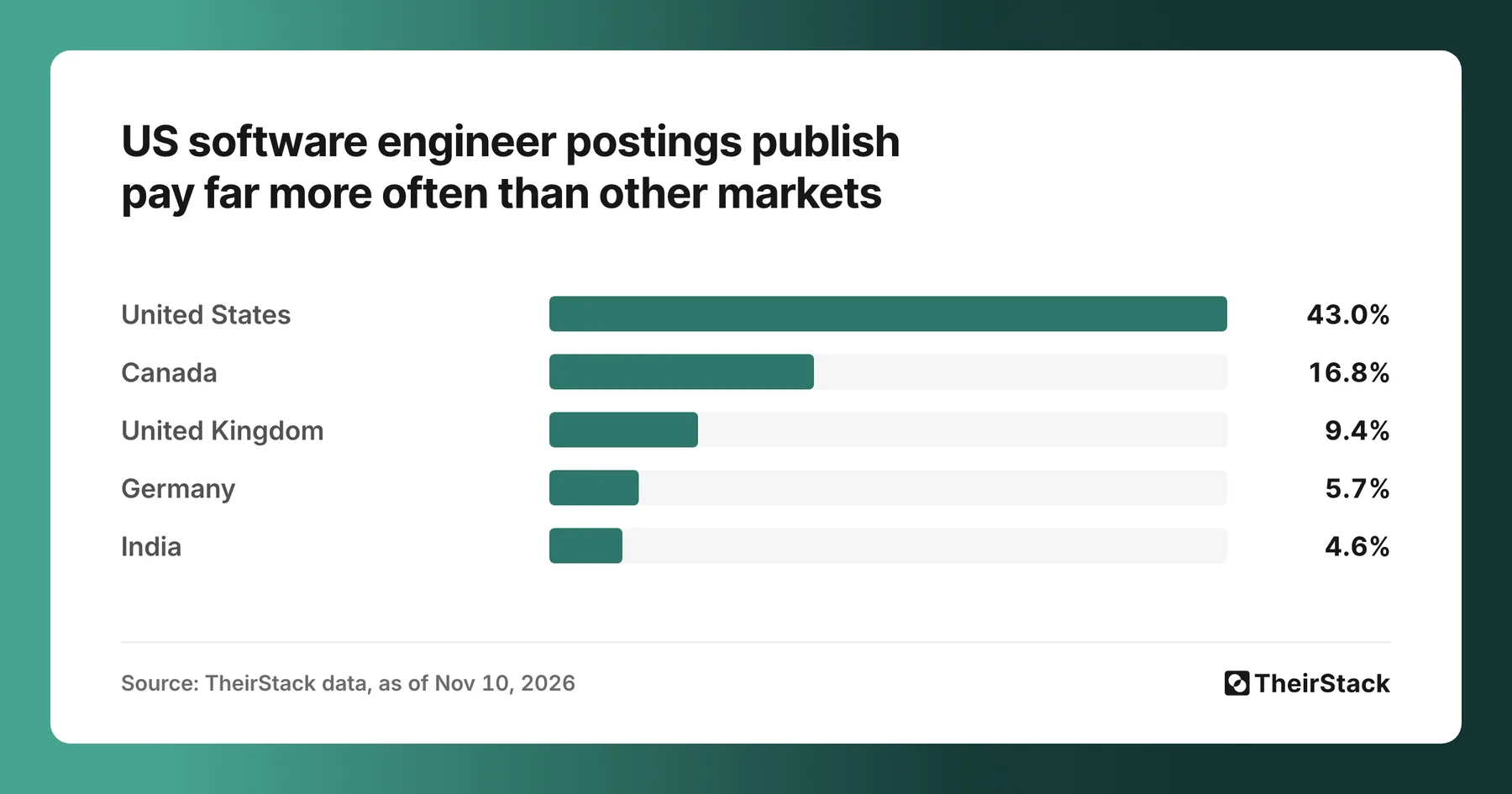 US software engineer postings publish pay far more often than other markets
The figure ranks the five markets by the share of open software engineer postings that publish a salary.
| Country | Open software engineer postings | Companies posting | Postings with salary | Share with salary | Median lower bound (annual USD) |
|---|---|---|---|---|---|
| United States | 21,782 | 5,413 | 9,361 | 43.0% | about $140,000 |
| India | 7,291 | 2,523 | 338 | 4.6% | not computed |
| United Kingdom | 2,348 | 990 | 220 | 9.4% | $90,000 to $100,000 |
| Canada | 1,471 | 589 | 247 | 16.8% | $90,000 to $95,000 |
| Germany | 1,438 | 676 | 82 | 5.7% | not computed |
All rows count open postings from direct employers with "software engineer" in the title, posted from 11 October to 10 November 2026. The median column is a range where the halfway point fell between two of the thresholds we tested.
How does posted pay change with seniority?
In the US the median lower bound rises from $70,000 to $75,000 for junior roles to $150,000 to $160,000 for senior ones. Mid-level postings sit between them, at $120,000 to $130,000.
| US seniority | Postings with salary | Median lower bound (annual USD) |
|---|---|---|
| Junior | 232 | $70,000 to $75,000 |
| Mid-level | 4,097 | $120,000 to $130,000 |
| Senior | 3,663 | $150,000 to $160,000 |
The three levels add up to 7,992 of the 9,361 salaried postings. The rest are staff or C-level roles, or postings we couldn't assign a level to. Junior roles are thin, with 232 salaried postings across 143 companies, so a few employers weigh heavily on that row.
How do you benchmark salaries from job postings, step by step?
You define the segment, pull its postings with the salary fields, keep the ones with pay and read medians by the cuts you need. Here is how we built the tables above.
Define the segment, pull its open postings, keep those with annual USD salary, group by place and seniority, then report medians and posting counts.
- Define the segment. We used the job title "software engineer", one country at a time and the last 30 days of postings. For a whole occupation, list every title it covers in the Job title filter.
- Pull open postings from direct employers. Company type set to direct employer drops recruiting agencies, which repost the same roles for clients. Job Closed set to open keeps live roles only, so roles that closed during the window drop out. Leave it off to count every posting in the window.
- Keep postings with pay. Each job carries
min_annual_salary_usdandmax_annual_salary_usd. We convert the published amount to USD at the exchange rate when the job was posted and keep the originalsalary_currency, so you can benchmark in local currency too. - Cut by place and level. Use
country_codes,state_code,locationorlatitude/longitudefor place, andseniorityfor level. - Read medians. Take the median of each bound per cut, and report the posting count next to it.
This is the pull behind the US row. It returns the 9,361 salaried postings at 1 API credit per job.
Using the TheirStack MCP, find US software engineer jobs that publish a salary.
- Job title contains "software engineer"
- Job country is the United States
- Posted in the last 30 days and still open
- Direct employers only
- Annual salary in USD is present
Return the count, then the first 10 with title, location, seniority, min_annual_salary_usd and max_annual_salary_usd.


curl --request POST \
  --url "https://api.theirstack.com/v1/jobs/search" \
  --header "Content-Type: application/json" \
  --header "Authorization: Bearer <YOUR_API_KEY>" \
  -d '{
    "job_title_or": ["software engineer"],
    "job_country_code_or": ["US"],
    "posted_at_gte": "2026-10-11",
    "posted_at_lte": "2026-11-10",
    "is_closed": false,
    "company_type": "direct_employer",
    "min_salary_usd": 0,
    "limit": 500,
    "offset": 0
}'- Job titlecontains any of software engineer
- Job countryUnited States
- Date postedlast 30 days
- Job Closedopen
- Company typedirect employer
- Annual salaryUSDminimum 0
The API call uses fixed dates so the results don't shift while you page through them 500 at a time.
You don't have to download every row to get a median. min_salary_usd keeps postings whose whole posted range sits at or above the value, so counting the segment at a few thresholds finds where half the postings fall. Each count with include_total_results and limit: 1 costs 1 credit, and nothing when there are no matches. We found the US median with two counts (5,342 postings start at $130,000 or more, 4,675 at $140,000 or more, against a halfway mark of 4,681) instead of a 9,361-credit pull. max_salary_usd does the same for the upper bound.
curl --request POST \
  --url "https://api.theirstack.com/v1/jobs/search" \
  --header "Content-Type: application/json" \
  --header "Authorization: Bearer <YOUR_API_KEY>" \
  -d '{
    "job_title_or": ["software engineer"],
    "job_country_code_or": ["US"],
    "posted_at_gte": "2026-10-11",
    "posted_at_lte": "2026-11-10",
    "is_closed": false,
    "company_type": "direct_employer",
    "min_salary_usd": 140000,
    "include_total_results": true,
    "limit": 1
}'Counts give you medians and percentiles. For a distribution, a regression or a cut the filters don't offer, pull the rows or take the jobs dataset as Parquet or CSV.
Which job datasets include annual salary in USD, and how full are they?
Our jobs dataset has min_annual_salary_usd filled on 18.99% of jobs and max_annual_salary_usd on 17.98%, as the job dataset dictionary lists them. avg_annual_salary_usd, the midpoint of the two, is on 17.86%. The closed jobs dataset runs slightly higher, with 20.12% for the minimum and 18.81% for the maximum.
Those are averages over every country and role, which matters when you compare compensation benchmarking data from any source. Fill depends on the market far more than on the field, as the country table shows (43% for US software engineers, 4.6% in India). Before you commit to a segment, count it once with a salary filter and once without, the way we did for each country above.
The dataset carries the published amount as well as the annual figure. salary_string holds the pay text as the source shows it, and min_salary, max_salary and salary_period hold the amount in the period it was published (hour, week, month, year). One mission software engineer posting in Costa Mesa reads "$166,000 - $220,000 a year" and comes through as 166000 and 220000 in the annual USD fields. salary_period is only set for jobs discovered since October 2026, so older rows give you the annual figure without the period it came from.
Coresignal, Hirebase and MixRank all list salary benchmarking among their use cases. On those pages, as of 10 November 2026, none publishes a salary fill rate for job postings, and none describes how it removes duplicate postings.
Is job posting salary data clean enough to benchmark with?
It is clean enough to count, as long as you read it as posted pay from employers that publish it. Duplicates, reposts and dates are handled in ways you can check, and missing pay is the real constraint.
One role posted through an ATS often appears on 3 to 5 job boards. We deduplicate across sources with algorithmic matching and manual checks, so each position counts once, under one stable id you can store and exclude later with job_id_not.
When a company reposts a job within 30 days of its original posting date, we treat it as a duplicate and drop it. A repost of an older job comes back with the new posting date, and date_reposted records when that happened. We don't yet flag every repost across sources, and that feature is in our backlog.
For dates, date_posted is the date the source gives and discovered_at is when we found the job. We discover 73% of jobs the same day they are posted, 91% by the end of the next day and 97% within three days, according to our freshness page. End your window two or three days before today if the last days matter to your series.
Missing pay is the part you can't fix. We record salary only when the source publishes it as structured data. We don't read it out of the description text, so a posting that mentions pay only in prose has empty salary fields. Every salary we return is one the source published, and your sample is the employers that publish pay in structured form.
Where does salary benchmarking from job postings fall short?
A posted range is what an employer advertises, not what the hire was paid. Read a median salary from job postings as the market's asking price.
The sample leans toward markets and employers that publish pay. In the UK, 220 salaried postings come from 101 companies, so a few employers with many roles can move the median. Germany's 82 and India's 338 are too few to benchmark software engineers at all.
Titles and levels need a check on your side. The Job title filter matches all the words in any order, so "software engineer" also returns a title like "Senior Software Systems, Battery Algorithms Engineer". Seniority comes from the posting, and a title with "Principal" can land as mid-level. We keep titles as employers wrote them and don't map them to an occupation code such as O*NET or ESCO, so an occupational segment is the list of titles you define.
Companies that don't post jobs, or post only on their own small career site, are under-counted. Our freshness page explains why roles that are never syndicated can arrive late or not at all.
Rerun this benchmark for your role and market
Open the search with your own title list and country, then add Annual salary (USD) with a minimum of 0 to see how many postings publish pay. Change Seniority level or Job location to read the cuts.
Open the US software engineer search in TheirStack. To run it from an AI assistant, connect our MCP server. For a full history to build a series from, start with the datasets docs.
 VS Code
 Windsurf
 Cline
 OpenCode
 Gemini
 Hermes
 OpenClaw
 Clay
 n8n
 Make
 Zapier
 Databar
 Salesforce
 HubSpot
 Attio
 Pipedrive
 Apollo
 Instantly
 ContactOut